How high availability works in Memgraph
This guide builds on the concepts introduced in how replication works. We recommend reading that page before continuing.
High availability (HA) in Memgraph ensures that the cluster can always serve queries, even when nodes fail. It is built on two foundations:
- Replication - multiple data instances hold copies of the data.
- Automatic failover - the system transparently promotes a new Main instance when needed.
A Memgraph HA cluster contains three types of instances:
- The MAIN instance on which the user can execute read and write queries.
- REPLICA instances that can only respond to read queries.
- COORDINATOR instances that manage the cluster state.
In HA documentation, MAIN and REPLICATE together are often referred to as data instances, because either one may become the Main during the cluster lifetime.
Coordinator instances do not store graph data and are therefore much lighter.
How Memgraph achieves High Availability
A typical highly available Memgraph cluster includes:
- 3 data instances (1 Main + 2 Replicas)
- 3 coordinators (1 Leader + 2 Followers)
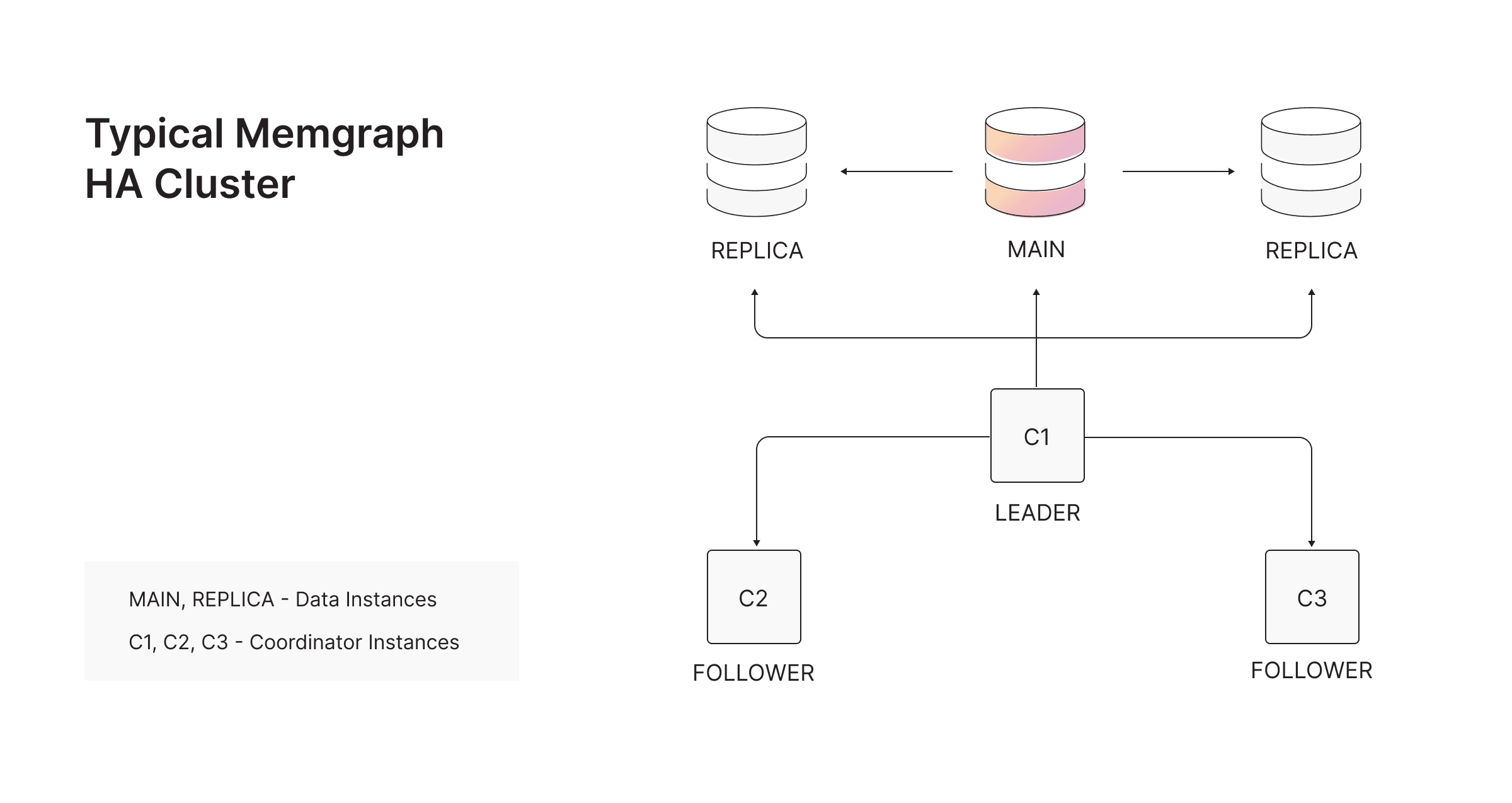
The constraint for number coordinators is only that it needs to be an odd number of them, greater than 1 (3, 5, 7, …). Users can create more than 3 coordinators, but the replication factor (RF) of 3 is a de facto standard in distributed databases.
The minimum valid data-instance setup is:
- 1 Main
- 1 Replica
If the Main fails, a Replica is automatically promoted.
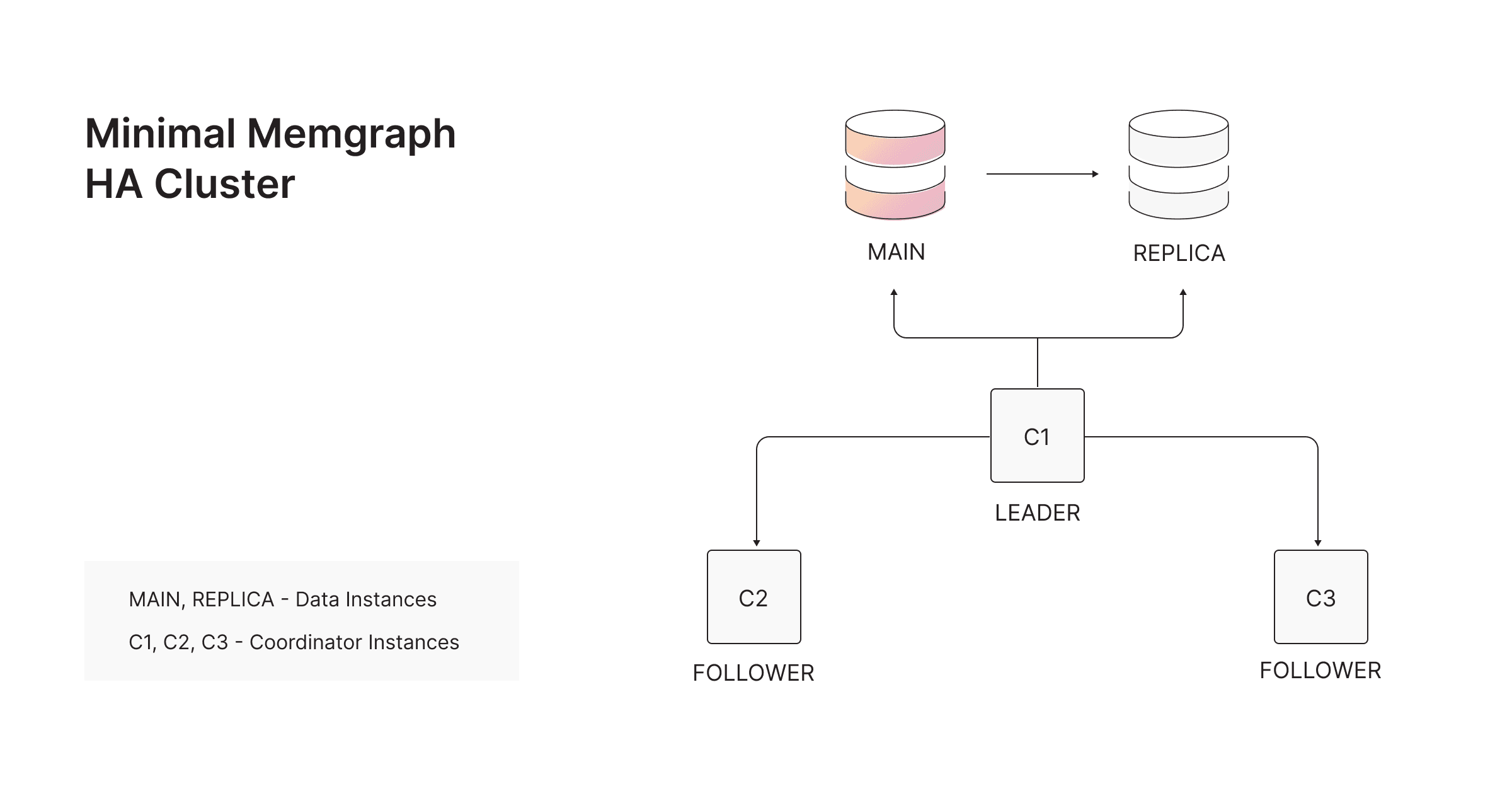
For achieving high availability, Memgraph uses the Raft consensus protocol for cluster coordination. Raft is easier to reason about than Paxos and widely adopted across distributed systems. As a design decision, Memgraph uses an industry-proven library NuRaft for the implementation of the Raft protocol.
Raft provides:
- Leader election among coordinator instances
- A replicated, durable cluster-management log
- Fault-tolerant decision-making via majority quorum
Raft is not a Byzantine fault-tolerant protocol. Using an odd number of coordinators ensures majority-based correctness.
The coordinator leader ensures:
- Exactly one Main exists
- Replicas are correctly registered
- Failover is triggered when needed
Coordinators themselves are redundant, making cluster orchestration highly available.
Data instance implementation
The data instance is your usual Memgraph standalone instance, with one key flag added:
--management-port- used to get the health state of the data instance from the leader coordinator
When a data instance runs in HA mode (i.e. --management-port is set), the
--init-file and --init-data-file flags are not supported. The instance
will fail to start if either flag is provided. This is because the cluster’s
leader coordinator drives role transitions (MAIN/REPLICA) and replication
setup, so executing arbitrary initialization queries on startup could conflict
with the cluster state. To bootstrap users or data in an HA cluster, run the
relevant queries through the MAIN after the cluster is formed.
Coordinator instance implementation
The coordinator is a small orchestration instance which is shipped in the same Memgraph binary as the data instance itself. For the system to be aware that its role is COORDINATOR, the user needs to specify four flags:
--coordinator-id- serves as a unique identifier of the coordinator--coordinator-port- used for synchronization and log replication between coordinators--coordinator-hostname- used on followers to ping the leader on the correct IP address (or FQDN/DNS name)--management-port- used to get the health state of the respective coordinator instance from the leader coordinator
The COORDINATOR instance is a very restricted instance, and it will
not respond to any queries that are not related to management of the cluster.
That means, you cannot run any data queries on the coordinator directly (we
will talk more about routing data queries in the next sections). However,
system information queries such as SHOW CONFIG, SHOW VERSION,
SHOW LICENSE INFO, SHOW BUILD INFO and SHOW STORAGE INFO are supported on
coordinators, as well as SET DATABASE SETTING, RELOAD BOLT_SERVER TLS and
RELOAD INTRA_CLUSTER TLS.
Since coordinators do not store user data, the following restrictions apply:
- Snapshots are automatically disabled on coordinators, even if
--storage-snapshot-interval-secis set. Thestorage.snapshot.intervalsetting is not registered on coordinators, so attempting to read or modify it viaSHOW DATABASE SETTING/SET DATABASE SETTINGreturns an unknown setting error. - The
--query-modules-directoryflag is ignored on coordinators. Coordinators do not execute data queries, so query modules are never loaded and the embedded Python runtime is not initialized. The flag is still accepted (so packaged defaults do not need to be overridden) but has no effect. - The
--init-fileand--init-data-fileflags are not supported on coordinators (and likewise not supported on data instances in HA mode). The instance will fail to start if either flag is provided.
When deploying coordinators to servers, you can use the instance of almost any size. Instances of 4GiB or 8GiB will suffice since coordinators’ job mainly involves network communication and storing Raft metadata. Coordinators and data instances can in theory be deployed on same servers (pairwise) but from the availability perspective, it is better to separate them physically.
RPC communication in the cluster
RPC (Remote Procedure Call) is a protocol for executing functions on a remote system. RPC enables direct communication in distributed systems and is crucial for replication and high availability tasks.
RPC (Remote Procedure Calls) are used for:
- Replication
- Cluster orchestration
- Health monitoring
- Failover triggers
Below is a cleaned-up categorization.
Coordinator → Coordinator RPCs
| RPC | Purpose | Description |
|---|---|---|
ShowInstancesRpc | Follower requests cluster state from leader. | Sent by a follower coordinator to the leader coordinator when a user executes SHOW INSTANCES through the follower. |
ShowCoordSettingsRpc | Follower requests coordinator settings. | Sent by a follower coordinator to the leader coordinator when a user executes SHOW COORDINATOR SETTINGS through the follower. |
YieldLeadershipRpc | Follower asks the leader to step down. | Sent by a follower coordinator to the leader coordinator when a user executes YIELD LEADERSHIP through the follower. |
AddCoordinatorRpc | Follower requests adding coordinator. | Sent by a follower coordinator to the leader coordinator when a user executes ADD COORDINATOR through the follower. |
RemoveCoordinatorRpc | Follower requests removing coordinator. | Sent by a follower coordinator to the leader coordinator when a user executes REMOVE COORDINATOR through the follower. |
RegisterInstanceRpc | Follower requests registering an instance. | Sent by a follower coordinator to the leader coordinator when a user executes REGISTER INSTANCE through the follower. |
UnregisterInstanceRpc | Follower requests unregistering an instance. | Sent by a follower coordinator to the leader coordinator when a user executes UNREGISTER INSTANCE through the follower. |
SetInstanceToMainRpc | Follower requests updating MAIN instance. | Sent by a follower coordinator to the leader coordinator when a user executes SET INSTANCE TO MAIN through the follower. |
DemoteInstanceRpc | Follower requests demoting an instance. | Sent by a follower coordinator to the leader coordinator when a user executes DEMOTE INSTANCE through the follower. |
UpdateConfigRpc | Follower requests updating config. | Sent by a follower coordinator to the leader coordinator when a user executes UPDATE CONFIG through the follower. |
ForceResetRpc | Follower requests resetting cluster state. | Sent by a follower coordinator to the leader coordinator when a user executes FORCE RESET through the follower. |
GetRoutingTableRpc | Follower requests a routing table. | Sent by a follower coordinator to the leader coordinator when a user connects using bolt+routing or executes SHOW ROUTING TABLE through the follower. |
CoordReplicationLagRpc | Follower requests replication lag info. | Sent by a follower coordinator to the leader coordinator when a user executes SHOW REPLICATION LAG through the follower. |
Coordinator → Data Instance RPCs
All of the following messages were sent by the leader coordinator.
| RPC | Purpose | Description |
|---|---|---|
PromoteToMainRpc | Promote a Replica to Main | Sent to a REPLICA in order to promote it to Main. |
DemoteMainToReplicaRpc | Demote a Main after failover | Sent to the old MAIN in order to demote it to REPLICA. |
RegisterReplicaOnMainRpc | Instruct Main to accept replication from a Replica | Sent to the MAIN to register a REPLICA on the MAIN. |
UnregisterReplicaRpc | Remove Replica from Main | Sent to the MAIN to unregister a REPLICA from the MAIN. |
EnableWritingOnMainRpc | Re-enable writes after Main restarts (deprecated) | Kept for backward compatibility (ISSU). No longer sent by coordinators — writing is implicitly enabled on promotion. |
GetDatabaseHistoriesRpc | Gather committed transaction counts during failover | Sent to all REPLICA instances in order to select a new MAIN during the failover process. |
StateCheckRpc | Health check ping (liveness) | Sent to all data instances for a liveness check. |
SwapMainUUIDRpc | Ensure Replica tracks the correct Main | Sent to REPLICA instances to set the UUID of the MAIN they should listen to. |
Main → Replica RPCs
All of the following messages were sent by the Main instance.
| RPC | Purpose | Description |
|---|---|---|
FrequentHeartbeatRpc | Liveness check | Sent to a REPLICA for liveness checks. |
HeartbeatRpc | Replication metadata sync | Sent to a REPLICA for transmitting timestamp, epoch, transaction, and commit information. |
PrepareCommitRpc | Send deltas; phase 1 of STRICT_SYNC | Sent REPLICA instances either as the first phase in STRICT_SYNC mode or as the only phase in other replication modes. It sends the delta stream during a write query. |
FinalizeCommitRpc | Commit confirmation in STRICT_SYNC | Sent REPLICA instances in STRICT_SYNC mode when all Replicas have acknowledged they are ready to commit. |
SnapshotRpc | Snapshot recovery | Sent a REPLICA for snapshot recovery so the REPLICA can catch up with the MAIN. |
WalFilesRpc | WAL segment recovery | Sent a REPLICA for WAL recovery so the REPLICA can catch up with the MAIN. |
CurrentWalRpc | Latest WAL file recovery | Sent a REPLICA for current/latest/unfinished WAL file recovery. |
SystemRecoveryRpc | Replicate system metadata | Sent a REPLICA for replicating system-level metadata (auth, multi-tenancy, etc.) and other non-graph information. |
RPC timeouts
Default RPC timeouts
For the majority of RPC messages, Memgraph uses a default timeout of 10s. This is to ensure that when sending a RPC request, the client will not block indefinitely before receiving a response if the communication between the client and the server is broken. The list of RPC messages for which the timeout is used is the following:
RPC timeout during replication of data
For RPC messages which are sending the variable number of storage deltas —
PrepareCommitRpc, CurrentWalRpc, and WalFilesRpc — it is not practical to
set a strict execution timeout, as the processing time on the replica side is
directly proportional to the number of deltas being transferred. To handle this,
the replica sends periodic progress updates to the main instance after
processing every 100,000 deltas. Since processing 100,000 deltas is expected to
take a relatively consistent amount of time, we can enforce a timeout based on
this interval. The default timeout for these RPC messages is 30 seconds, though
in practice, processing 100,000 deltas typically takes less than 3 seconds.
RPC timeout during replica recovery
SnapshotRpc is also a replication-related RPC message, but its execution time
is tracked a bit differently from RPC messages shipping deltas. The replica
sends an update to the main instance after completing 1,000,000 units of work.
The work units are assigned as follows:
- Processing nodes, edges, or indexed entities (label index, label-property index, edge type index, edge type property index) = 1 unit
- Processing a node inside a point or text index = 10 units
- Processing a node inside a vector index (most computationally expensive) = 1,000 units
With this unit-based tracking system, the REPLICA is expected to report progress approximately every 2–3 seconds. Given this, a timeout of 60 seconds is set to avoid unnecessary network instability while ensuring responsiveness. On every report of the progress by the REPLICA, the timeout of 60 seconds will be restarted, as the state of recovery is considered to be stable.
Except for timeouts on read and write operations, Memgraph also has a timeout of 5s for sockets when establishing a connection. Such a timeout helps in having a low p99 latencies when using the RPC stack, which manifests for users as smooth and predictable network communication between instances.
In the table below, we have the full outline of the RPC messages that are sent in the cluster to ensure high availability, with timeouts.
| RPC message request | source | target | timeout |
|---|---|---|---|
ShowInstancesReq | Coordinator | Coordinator | 10s |
DemoteMainToReplicaReq | Coordinator | Data instance | 10s |
PromoteToMainReq | Coordinator | Data instance | 10s |
RegisterReplicaOnMainReq | Coordinator | Data instance | 10s |
UnregisterReplicaReq | Coordinator | Data instance | 10s |
ReplicationLagReq | Coordinator | Data instance | 5s |
GetDatabaseHistoriesReq | Coordinator | Data instance | 10s |
StateCheckReq | Coordinator | Data instance | 5s |
SwapMainUUIDReq | Coordinator | Data instance | 10s |
UpdateDataInstanceConfigReq | Coordinator | Data instance | 10s |
FrequentHeartbeatReq | Main | Replica | 5s |
HeartbeatReq | Main | Replica | 10s |
SystemRecoveryReq | Main | Replica | 30s |
PrepareCommitRpc | Main | Replica | proportional |
FinalizeCommitReq | Main | Replica | 10s |
SnapshotRpc | Main | Replica | proportional |
WalFilesRpc | Main | Replica | proportional |
CurrentWalRpc | Main | Replica | proportional |
EnableWritingOnMainReq was removed in Memgraph 3.13. It was never sent —
writing on a newly promoted MAIN is enabled through the writing_enabled flag
carried inside PromoteToMainRpc. Its Prometheus counters were removed along
with it.
Follower-to-leader forwarding timeouts
Cluster management queries can be run on any coordinator; a follower forwards them to the leader over RPC. From Memgraph 3.13, each of these RPCs has an explicit timeout. They run on the caller’s Bolt session thread, so without one, a session would block forever against a leader that is reachable but stuck.
The four instance operations must outlast the work they trigger on the leader, or a follower would report failure for an operation the leader has already committed to Raft. Their budgets are the sum of that work plus headroom, where a Raft commit is capped at 3 seconds and each RPC from the leader to a data instance is capped by its entry in the table above.
| RPC message request | source | target | timeout | Budget breakdown |
|---|---|---|---|---|
RegisterInstanceReq | Coordinator | Coordinator | 30s | Raft commit + demote the new replica + register it |
UnregisterInstanceReq | Coordinator | Coordinator | 20s | Raft commit + one RPC to the current MAIN |
DemoteInstanceReq | Coordinator | Coordinator | 20s | Raft commit + one RPC to the current MAIN |
SetInstanceToMainReq | Coordinator | Coordinator | 60s | Raft commit + one SwapMainUUID per other instance + promote the new MAIN |
AddCoordinatorReq | Coordinator | Coordinator | 10s | Raft commit only |
RemoveCoordinatorReq | Coordinator | Coordinator | 10s | Raft commit only |
UpdateConfigReq | Coordinator | Coordinator | 10s | Raft commit only |
ForceResetReq | Coordinator | Coordinator | 60s | Unbounded leader-side work — see the note below |
SetCoordinatorSettingReq | Coordinator | Coordinator | 10s | Raft commit only |
GetRoutingTableReq | Coordinator | Coordinator | 10s | Read served by the leader |
CoordReplLagReq | Coordinator | Coordinator | 10s | Read served by the leader |
CreateRoleReq | Coordinator | Coordinator | 10s | Raft commit only |
DropRoleReq | Coordinator | Coordinator | 10s | Raft commit only |
GrantPrivilegeReq | Coordinator | Coordinator | 10s | Raft commit only |
RevokePrivilegeReq | Coordinator | Coordinator | 10s | Raft commit only |
GetRolesReq | Coordinator | Coordinator | 10s | Read served by the leader |
GetRolePrivilegesReq | Coordinator | Coordinator | 10s | Read served by the leader |
SetInstanceToMainReq sends one SwapMainUUID per other instance, so its cost
grows with the number of data instances. The 60s budget comfortably covers five
instances. Beyond that, a follower can time out before the leader answers — no
fixed value bounds it. Run SET INSTANCE ... TO MAIN directly on the leader in
very large clusters.
ForceResetReq triggers a reconciliation that retries under a 1s–60s backoff
for as long as the coordinator stays leader, so the leader-side work has no
upper bound at all. The 60s budget only keeps a genuinely wedged leader from
blocking the session — hitting it does not mean the reset failed, and
FORCE RESET CLUSTER STATE
is safe to re-run.
The role and privilege RPCs are used by coordinator
authentication:
GetRolesReq in particular is sent on every query of an SSO session, because
coordinator privileges are re-derived from the leader’s committed role set
rather than cached at login.
System transaction timeouts
MAIN-to-REPLICA system-delta RPCs are sent while committing a system
transaction, so they must not block indefinitely either. From Memgraph 3.13 each
carries a 10 second timeout; a timeout marks the REPLICA as BEHIND and
defers to system recovery.
| RPC message request | source | target | timeout |
|---|---|---|---|
UpdateAuthDataReq | Main | Replica | 10s |
DropAuthDataReq | Main | Replica | 10s |
FinalizeSystemTxReq | Main | Replica | 10s |
CreateDatabaseReq | Main | Replica | 10s |
DropDatabaseReq | Main | Replica | 10s |
SuspendDatabaseReq | Main | Replica | 10s |
ResumeDatabaseReq | Main | Replica | 10s |
RenameDatabaseReq | Main | Replica | 10s |
TenantProfileReq | Main | Replica | 10s |
SetParameterReq | Main | Replica | 10s |
UnsetParameterReq | Main | Replica | 10s |
DeleteAllParametersReq | Main | Replica | 10s |
Intra-cluster TLS
By default, the communication between instances in a high-availability cluster is unencrypted. To secure it, Memgraph supports intra-cluster TLS, which encrypts all internal cluster traffic using mutual TLS (mTLS). When enabled, TLS protects the communication on:
- the management server (health checks between the leader coordinator and the instances),
- the replication server (data replication between MAIN and REPLICA instances), and
- the coordinator server (synchronization and log replication between coordinators).
Intra-cluster TLS is independent of Bolt SSL/TLS.
Bolt encryption secures client-to-instance connections and is configured
separately with the --bolt-cert-file and --bolt-key-file flags, while
intra-cluster TLS secures the internal cluster communication described above.
Enabling intra-cluster TLS
Intra-cluster TLS is enabled by setting the following three flags on every instance (coordinators and data instances) in the cluster:
| Flag | Description |
|---|---|
--cluster-cert-file | Certificate file used for intra-cluster TLS communication. |
--cluster-key-file | Key file used for intra-cluster TLS communication. |
--cluster-ca-file | File storing the certificate of the Certificate Authority you trust for intra-cluster TLS communication. |
All three flags must be set together. If only some of them are provided, the instance refuses to start to avoid running in a partially-configured TLS state. When all three are empty, intra-cluster TLS is disabled and communication is unencrypted. Because mTLS is used, every instance must present a certificate that is trusted by the configured Certificate Authority, and all instances in the cluster must be started with the TLS flags.
Reloading intra-cluster TLS certificates at runtime
You can rotate the intra-cluster TLS certificates without restarting the
cluster by running the RELOAD INTRA_CLUSTER TLS Cypher query. Replace the
certificate and key files on disk at the paths configured with
--cluster-cert-file, --cluster-key-file, and --cluster-ca-file, then run:
RELOAD INTRA_CLUSTER TLS;RELOAD INTRA_CLUSTER TLS reloads both the client and server connections, so
new connections will start using the new certificates.
This is the intra-cluster counterpart of RELOAD BOLT_SERVER TLS, which
reloads the Bolt server certificates. Both queries require the RELOAD_TLS
privilege.
For more details on reloading certificates, see the
SSL encryption
page.
Automatic failover
Automatic failover is driven by periodic health checks performed by the leader coordinator on all data instances. An instance is considered alive if it responds to these checks; if it does not, it is marked as down.
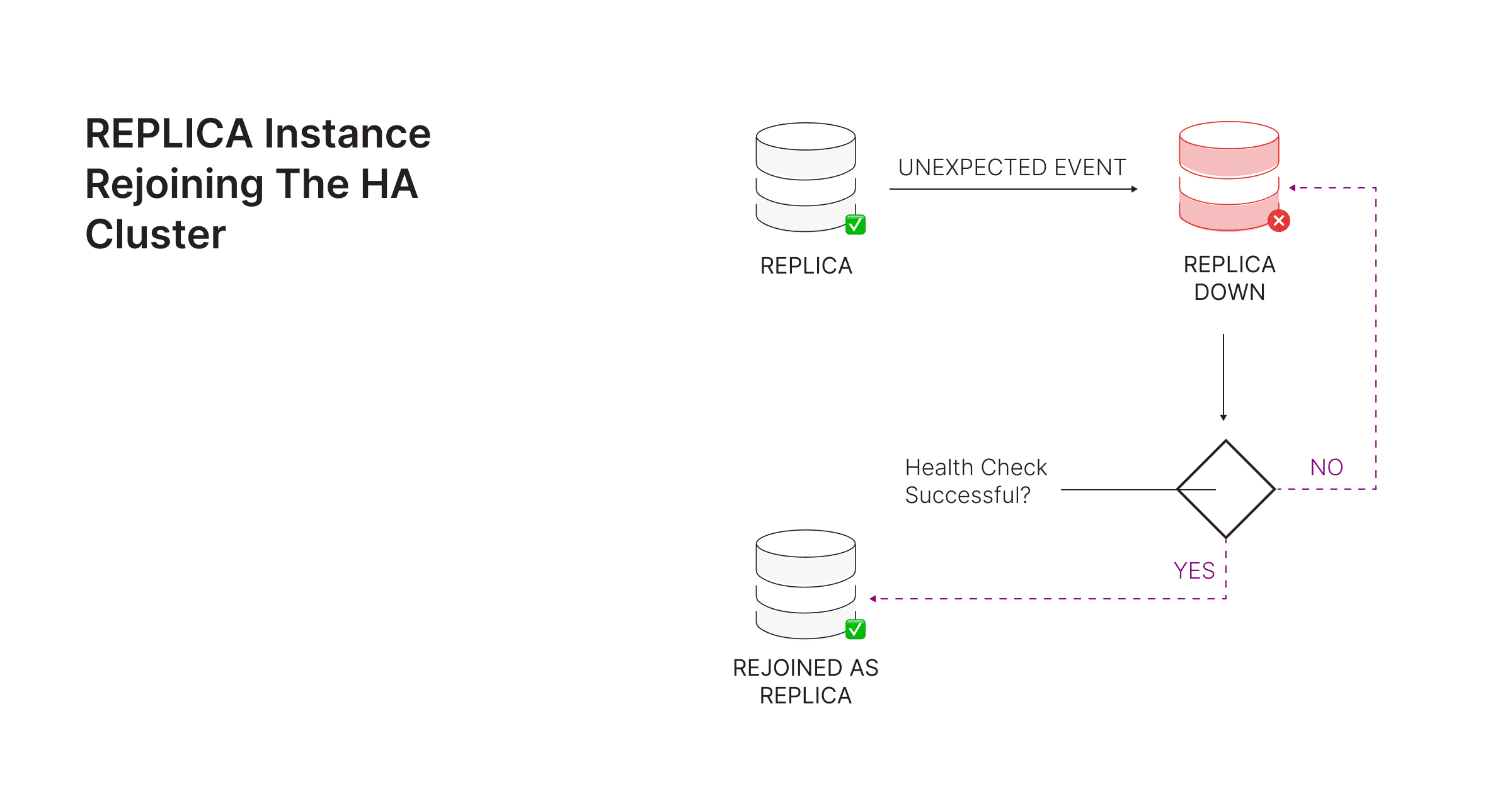
When a Replica goes down
If a REPLICA instance goes down, it will always rejoin the cluster as a REPLICA once it becomes healthy again. No failover action is required.
When the Main goes down
If the MAIN instance is detected as down, the coordinator may initiate a failover to select a new MAIN from the set of alive REPLICAs.
The failover process works as follows:
- The coordinator selects one of the alive replicas as the new MAIN candidate.
- It records this decision in the Raft log.
- On the next heartbeat to the selected replica, the coordinator sends an RPC
request (
PromoteToMainReq) instructing it to promote itself from REPLICA to MAIN and providing information about the other replicas it should replicate to. - Once the promotion succeeds, the new MAIN begins replicating data to the other instances and starts accepting write queries.
Instance health checks
The coordinator performs health checks on each instance at a fixed interval,
configured with the instance_health_check_frequency_sec coordinator setting.
An instance is not considered down until it has failed to respond for the full
duration specified by the instance_down_timeout_sec coordinator setting. Both
settings can be changed at runtime using
SET COORDINATOR SETTING.
Example
With the default settings:
instance_health_check_frequency_sec=1instance_down_timeout_sec=5
…the coordinator will send a health check RPC (StateCheckRpc) every second. An
instance is marked as down only after five consecutive missed responses (5
seconds ÷ 1 second).
Usually, the health check reports instantly, and only in severe cases of network failure, it will timeout in 30 seconds.
Depending on the data instance role, we have 2 scenarios:
- Replica instance fails to respond
If a REPLICA fails to respond:
- The leader coordinator simply retries on the next scheduled health check.
- Once the instance becomes reachable again, it always rejoins the cluster as a REPLICA.
- Main instance fails to respond
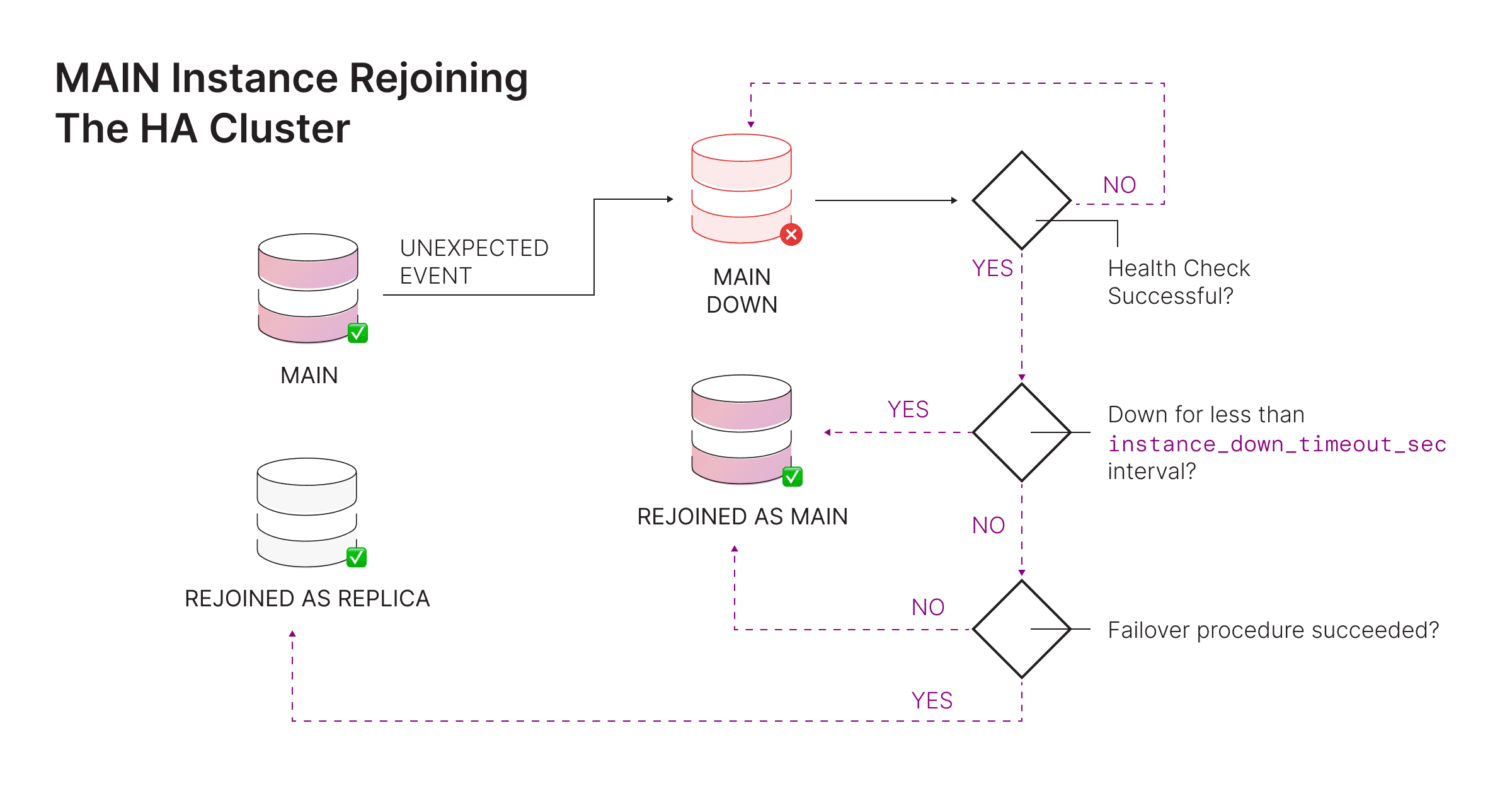
If the MAIN instance fails to respond, two cases apply:
- Down for less than
instance_down_timeout_secThe instance is still considered alive and will rejoin as MAIN when it responds again. - Down for longer than
instance_down_timeout_secThe coordinator initiates the failover procedure. What the old MAIN becomes afterward depends on the outcome:- Failover succeeds: the old MAIN rejoins as a REPLICA.
- Failover fails: the old MAIN retains authority and rejoins as MAIN when it becomes reachable.
For guidance on configuring health checks, see the Best practices.
Choosing the new MAIN
During failover, the coordinator must select a new main instance from available replicas, as some may be offline. The leader coordinator queries each live replica to retrieve the committed transaction count for every database.
Note: For every database in this terminologyrefers to environments using multi-tenancy, where multiple isolated databases/graphs exist within a single instance. If multi-tenancy is not used, the coordinator retrieves the committed transaction count only for the default memgraph database.
The selection algorithm prioritizes data recency using a two-phase approach:
- Database majority rule: The coordinator identifies which replica has the highest committed transaction count for each database. The replica that leads in the most databases becomes the preferred candidate.
- Total transaction tiebreaker: If multiple replicas tie for leading the most databases, the coordinator sums each replica’s committed transactions across all databases. The replica with the highest total becomes the new main.
This approach ensures the new main instance has the most up-to-date data across the cluster while maintaining consistency guarantees.
Old MAIN rejoining
When the old MAIN instance comes back online, it cannot resume as MAIN automatically. The coordinator keeps track of which instance most recently served as MAIN and ensures a controlled transition.
To demote the old MAIN to a REPLICA, the leader coordinator sends two RPC requests in order:
DemoteMainToReplicaReq- instructs the old MAIN to demote itself to a REPLICA.- Store current MAIN UUID - updates the old instance (now a REPLICA) with the machine UUID of the current MAIN so it can correctly begin replication.
After these steps, the old MAIN fully reenters the cluster as a REPLICA.
Ensuring replicas follow the correct MAIN
Each REPLICA stores the UUID of the MAIN instance it should follow. In certain failure scenarios, such as a network partition, the MAIN may still be able to communicate with a REPLICA even though the coordinator cannot reach the MAIN. From the coordinator’s perspective, the MAIN appears down, while from the REPLICA’s perspective, it appears alive.
This situation can lead to split-brain behavior, where failover procedure is triggered and multiple MAINs briefly exist, with replicas potentially following different leaders.
To prevent this, the coordinator manages MAIN UUIDs carefully:
- When a new MAIN is selected, the coordinator generates a new, unique MAIN UUID that no existing MAIN has.
- The new MAIN adopts this UUID when promoted, ensuring replicas can reliably distinguish which MAIN is authoritative.
If a REPLICA goes down and later rejoins, the MAIN may have changed during its
absence. To ensure the REPLICA follows the correct MAIN, the coordinator sends a
SwapMainUUIDRpc request, updating the REPLICA with the UUID of the current
MAIN.
This guarantees all REPLICAs consistently replicate from the correct leader and prevents divergence across the cluster.
Replication scenarios
Force sync of data
Earlier, we explained how Memgraph selects the most up-to-date alive instance during failover.
However, a replica that was down at the time of failover might actually hold more recent data than any of the replicas that were online. When this happens, Memgraph performs a force sync of that REPLICA.
A force sync occurs when a previously unreachable instance had a more up-to-date state than the replica promoted to MAIN. Once that instance rejoins the cluster, it undergoes a controlled recovery process:
- The REPLICA resets its storage.
- It receives all committed transactions from the current MAIN to rebuild an accurate and consistent state.
- Its original durability files are preserved in
.olddirectories insidedata_directory/snapshotsanddata_directory/wal. These allow administrators to attempt manual recovery if necessary. The.olddirectory is reused on subsequent recoveries, meaning only one backup copy is kept at a time.
Use the --storage-backup-dir-enabled flag to control this behavior:
true(default) - Old durability files are moved to.olddirectoriesfalse- Old durability files are deleted immediately
The possibility of data loss during failover depends on the configured replication mode:
SYNC (default)
- Provides strong availability guarantees but allows a non-zero RPO (loss of committed data).
- This can occur because the replica promoted to MAIN may not have received the latest commits from the old MAIN before failure.
- The design prioritizes keeping the MAIN writable for as long as possible.
ASYNC
- Similar to
SYNC, but with an even higher chance of data loss because the MAIN continues committing freely regardless of replica status.
STRICT_SYNC
- Ensures zero data loss under all failover scenarios.
- Achieves this by using a two-phase commit protocol, at the cost of reduced throughput.
Learn more about the implications of different replication modes.
Actions on follower coordinators
Follower coordinators never execute cluster operations themselves. Instead, they
act as a transparent entry point: every cluster query you run on a follower is
forwarded to the current leader, executed there, and the leader’s answer is
returned to you. This holds both for state-changing operations (registering and
unregistering data instances, promoting and demoting instances, adding and
removing coordinators, updating configuration, forcing a cluster state reset,
yielding
leadership)
and for read-only ones (SHOW INSTANCES, SHOW COORDINATOR SETTINGS, SHOW REPLICATION LAG, and bolt+routing routing table requests).
As a result you can point your tooling at any coordinator without first having to discover which one is the leader.
Why followers never answer from local state
A follower’s own Raft state is not enough to describe the cluster: health of the data instances is only known to the leader, which is the coordinator that pings them. For this reason followers do not fall back to a local, partial answer when the leader cannot be reached. Instead:
- Read queries return an empty result set together with a warning
notification (
LeaderNotReachable, orReplicationLagUnavailableforSHOW REPLICATION LAG). - State-changing queries fail with an error telling you that the coordinator is not the leader, or that the leader could not be found.
Both cases mean “cluster state unknown — retry”, and both are expected during the brief window of a leader election or while a newly elected leader is still taking over the cluster. See Error handling for the exact messages.
The one exception is the bolt+routing routing table: a coordinator that Raft
elected as leader answers routing requests from its own Raft state even before it
has finished taking over the cluster, so that clients can keep routing queries
during the leadership transition.
Raft-first operations and the reconciliation loop
The coordinator follows a Raft-first pattern for all cluster operations (registering, unregistering, promoting, demoting instances). This means every state change is first committed to the Raft log and acknowledged by a majority of coordinators before the operation returns success to the user.
After the Raft commit, the coordinator sends RPCs to data instances (e.g.,
PromoteToMainRpc, DemoteMainToReplicaRpc, RegisterReplicaOnMainRpc,
UnregisterReplicaRpc) on a best-effort basis. If an RPC fails due to a
transient network issue, the operation still succeeds from the user’s
perspective because the Raft log is the single source of truth.
How the reconciliation loop works
The coordinator leader runs a periodic reconciliation loop that automatically detects and corrects discrepancies between the desired state (Raft log) and the actual state of data instances. Specifically:
- Missing replicas on main: If a replica exists in the Raft state but is not
registered on the current main instance, the reconciliation loop sends a
RegisterReplicaOnMainRpcto the main. - Stale replicas on main: If the main instance reports a replica that no
longer exists in the Raft state, the reconciliation loop sends an
UnregisterReplicaRpcto remove it.
This self-healing behavior means the cluster automatically recovers from transient RPC failures without user intervention. Users only need to retry an operation if the Raft commit itself fails.
Instance restarts
Restarting data instances
Both MAIN and REPLICA instances may fail and later restart.
-
When a REPLICA instance comes back online, it uses the MAIN UUID provided by the coordinator (via the
SwapMainUUIDReqmessage) to determine which MAIN to follow. This synchronization happens automatically once the coordinator’s health check (“ping”) succeeds. -
When the MAIN instance restarts, the coordinator confirms the instance’s state through health checks. Writing is enabled once the coordinator verifies the instance is healthy and its role is confirmed by sending
PromoteToMainRpcto the data instance.
This ensures that instances safely rejoin the cluster without causing inconsistencies.
Restarting coordinator instances
If a coordinator instance crashes and is restarted, it does not lose any state. All coordinator metadata, RAFT logs and RAFT snapshots, is persisted on durable storage, ensuring full recovery on restart.
More details are available in the section on RAFT implementation.
In-service software upgrade (ISSU)
The cluster’s ability to safely restart instances one at a time is what enables in-service software upgrades (ISSU) — upgrading Memgraph to a newer version with zero downtime.
An ISSU is a rolling upgrade: each instance is stopped and restarted on the new version while the rest of the cluster keeps serving queries. To avoid downtime and data loss, instances are upgraded in a fixed order:
- Replicas one at a time.
- The main instance — its restart triggers the standard automatic failover, so a freshly upgraded replica takes over as the new main.
- Coordinator followers
- The coordinator leader whose restart triggers a Raft leader re-election.
For the full step-by-step procedure, including backups and Helm chart configuration, see the ISSU section on the Kubernetes setup page. The same flow applies to native deployments.
RAFT implementation
NuRaft persists all critical RAFT state to durable storage by default. This includes:
- RAFT logs
- RAFT snapshots
- Cluster connectivity metadata
Persisting connectivity information is essential. Without it, a coordinator could not safely rejoin the cluster after a restart.
Information about logs and snapshots is stored under one RocksDB instance in the
high_availability/raft_data/logs directory stored under the top-level
--data-directory folder. All the data stored there is recovered in case the
coordinator restarts.
Data about other coordinators is recovered from the
high_availability/raft_data/network directory stored under the top-level
--data-directory folder. When the coordinator rejoins, it will reestablish the
communication with other coordinators and receive updates from the current
leader.
First start
When coordinators start for the first time, each initializes its logs and
network durability stores. From that moment on:
- Every RAFT log entry sent to a coordinator is also written to disk.
- The server configuration is updated whenever a new coordinator joins.
- Logs are generated for all user actions and failover-related operations.
- RAFT snapshots are created every N log entries (currently every 5 logs).
This design ensures that the coordinator can reliably recover its full RAFT state at any time, preserving both consistency and cluster membership information.
Restart of coordinator
In case of the coordinator’s failure, on the restart, it will read information
about other coordinators stored under high_availability/raft_data/network
directory.
From the network directory we will recover the server state before the
coordinator stopped, including the current term, for whom the coordinator voted,
and whether election timer is allowed.
It will also recover the following server config information:
- other servers, including their endpoints, id, and auxiliary data
- ID of the previous log
- ID of the current log
- additional data needed by nuRaft
The following information will be recovered from a common RocksDB logs
instance:
- current version of
logsdurability store - snapshots found with
snapshot_id_prefix in database:- coordinator cluster state - all data instances with their role (main or replica), all coordinator instances and UUID of main instance which replica is listening to
- last log idx
- last log term
- last cluster config
- logs found in the interval between the start index and the last log index
- data - each log holds data on what has changed since the last state
- term - nuRAFT term
- log type - nuRAFT log type
Handling durability errors
If snapshots are not correctly stored, the exception is thrown and left for the nuRAFT library to handle the issue. Logs can be missed and not stored since they are compacted and deleted every two snapshots and will be removed relatively fast.
Memgraph throws an error when failing to store cluster config, which is updated
in the high_availability/raft_data/network folder. If this happens, it will
happen only on the first cluster start when coordinators are connecting since
coordinators are configured only once at the start of the whole cluster. This is
a non-recoverable error since in case the coordinator rejoins the cluster and
has the wrong state of other clusters, it can become a leader without being
connected to other coordinators.
Recovering from errors
Distributed systems can fail in many different ways. Memgraph is designed to be resilient to network failures, omission faults, and independent machine failures. However, like most systems based on Raft, it does not tolerate Byzantine failures.
To understand how Memgraph behaves under failure, it is useful to consider the Recovery Time Objective (RTO) - the maximum acceptable duration for which an instance or cluster can be unavailable.
Memgraph clusters contain two categories of instances - coordinators and data instances and their failure scenarios must be examined separately.
Coordinator failures
Raft requires a majority of coordinators to remain alive to continue operating.
- With one coordinator down in a 3-node Raft cluster (RF = 3), the cluster still has quorum, so RTO = 0 - the system remains fully available.
- With two or more coordinators down, quorum is lost. In this case, RTO depends solely on how long it takes for enough coordinators to come back online.
Replica failures
A replica’s failure has different consequences depending on its replication mode:
- STRICT_SYNC replica fails
- Writes on the MAIN are blocked until the replica becomes available again.
- Reads remain allowed on MAIN and other replicas.
- SYNC or ASYNC replica fails
- The MAIN continues accepting writes.
- Reads remain available everywhere.
- A write that couldn’t reach a SYNC replica still succeeds and is reported
with a
SyncReplicationFailurewarning notification.
Thus, only STRICT_SYNC replicas can directly impact write availability.
Main instance failure
When the MAIN instance becomes unavailable, the failure is handled by the leader coordinator using two user-configured parameters:
instance_health_check_frequency_sec: how often health checks are sent (configurable viaSET COORDINATOR SETTING)instance_down_timeout_sec: how long an instance must remain unresponsive before it is considered down (configurable viaSET COORDINATOR SETTING)
Once the coordinator gathers enough evidence that the MAIN is down, it begins a failover procedure using a small number of RPC messages. The exact time required depends on network latency and instance proximity.
If the selected replica (promoted to MAIN) has the most recent committed data, failover completes with zero data loss.
Databases broken by recovery failure
By default, a data instance whose durability files are corrupt refuses to boot
and its role in the cluster goes down. If you run data instances with
--storage-allow-recovery-failure=true,
such an instance boots instead, with the affected database in a broken state
(empty placeholder, on-disk files untouched). Only that database is affected —
all healthy databases on the instance keep serving.
- Broken database on a REPLICA: it self-heals. Because the broken placeholder comes up empty with a fresh epoch, the MAIN detects the replica is behind, drives it into recovery and sends a full snapshot, which clears the broken state. No operator action is required.
- Broken database on the MAIN: the cluster does not automatically fail
over based on per-database broken state — a MAIN that is broken for one
database but otherwise healthy stays MAIN, so the cluster never thrashes
over a single corrupt database. Replicas keep serving reads of their healthy
copy. The admin recovers the MAIN in place with
RECOVER SNAPSHOT, after which the database rejoins replication normally.
See recovery failure handling for the full behavior and restoration paths.
Raft configuration parameters
Several RAFT-related settings play a key role in maintaining stable cluster behavior.
The leader coordinator sends heartbeat messages to all follower coordinators once per second. These heartbeats allow followers to confirm that the leader is healthy.
This timing interacts closely with the leader election timeout, which is a randomized interval between 2000 ms and 4000 ms. A follower starts a new election only if it does not receive a heartbeat within this timeout window.
Additionally, the leadership expiration is fixed at 2000 ms, ensuring that the cluster cannot enter a state where multiple leaders coexist.
These values are chosen to allow the cluster to tolerate minor and temporary network delays without triggering unnecessary leadership changes, improving overall stability.