Text2Cypher for Atomic GraphRAG: The Analytical Retrieval Approach in Action
GraphRAG often gets discussed as if it were one retrieval pattern. It is not. The shape of its pipeline heavily depends on the shape of the business questions being asked.
Some questions ask for an exact value. Some need a focused slice of the graph around a node. Some need broader synthesis across a larger subgraph. Treat all of them the same and the system gets messy fast.
This article focuses on the simplest of those question types:
Analytical questions answered with Text-to-Cypher retrieval pattern.
That simplicity does not make it unimportant. It makes it useful for the straightforward data-fetching questions required direct, structured answers.
Common GraphRAG Question Types
A useful way to think about GraphRAG questions is to group them into different types of question types that have different retrieval patterns. The three common retrieval types are:
- Analytical Approach: the user wants an exact answer that can be retrieved with a database query.
- Local Approach: the user needs target information within a small segment of the dataset.
- Global Approach: the user is asking for themes, patterns, or broader conclusions across a larger part of the graph.
Those categories matter because each one calls for a different retrieval pattern. In this article, our focus is on the Analytical question type that utilizes Text2Cypher retrieval pattern.
Text-to-Cypher for Analytical GraphRAG Questions
Text-to-Cypher (AKA Text2Cypher) is the pattern used when a natural language question can be answered by generating a Cypher query and running it against the graph.
It is the right fit when the question is asking for something exact, such as:
- whether a node exists
- how many records match a condition
- which group has the highest count
- what a filtered result set looks like
- what value should be returned in a table or scalar output
At a high level, the flow is simple:
- inspect the schema
- generate the Cypher query
- execute the query
- return the result
It is not trying to assemble a long narrative context. It is not doing broader graph exploration. It is not summarizing multiple communities or traversing out from a pivot node. It is answering a precise question with a precise query. That is why the output for this pattern is usually a scalar value, a row, or a table.
Atomic GraphRAG for Analytical Text2Cypher Queries
To understand why this pattern matters, it helps to place it inside the broader Atomic GraphRAG context.
Atomic GraphRAG is an execution approach where GraphRAG pipelines are built as single queries by chaining together Memgraph's built-in database-side primitives instead of stitching logic across multiple systems. In practice, that means the database does more of the retrieval work directly, rather than acting as a passive store while the real pipeline lives elsewhere.
That matters because production-grade GraphRAG systems often sprawl. Search happens in one place. Expansion happens somewhere else. Prompt assembly gets added on top. The more handoffs you introduce, the harder the system becomes to validate and maintain. Atomic GraphRAG is meant to reduce that sprawl and make the feedback loop and iteration cycle shorter.
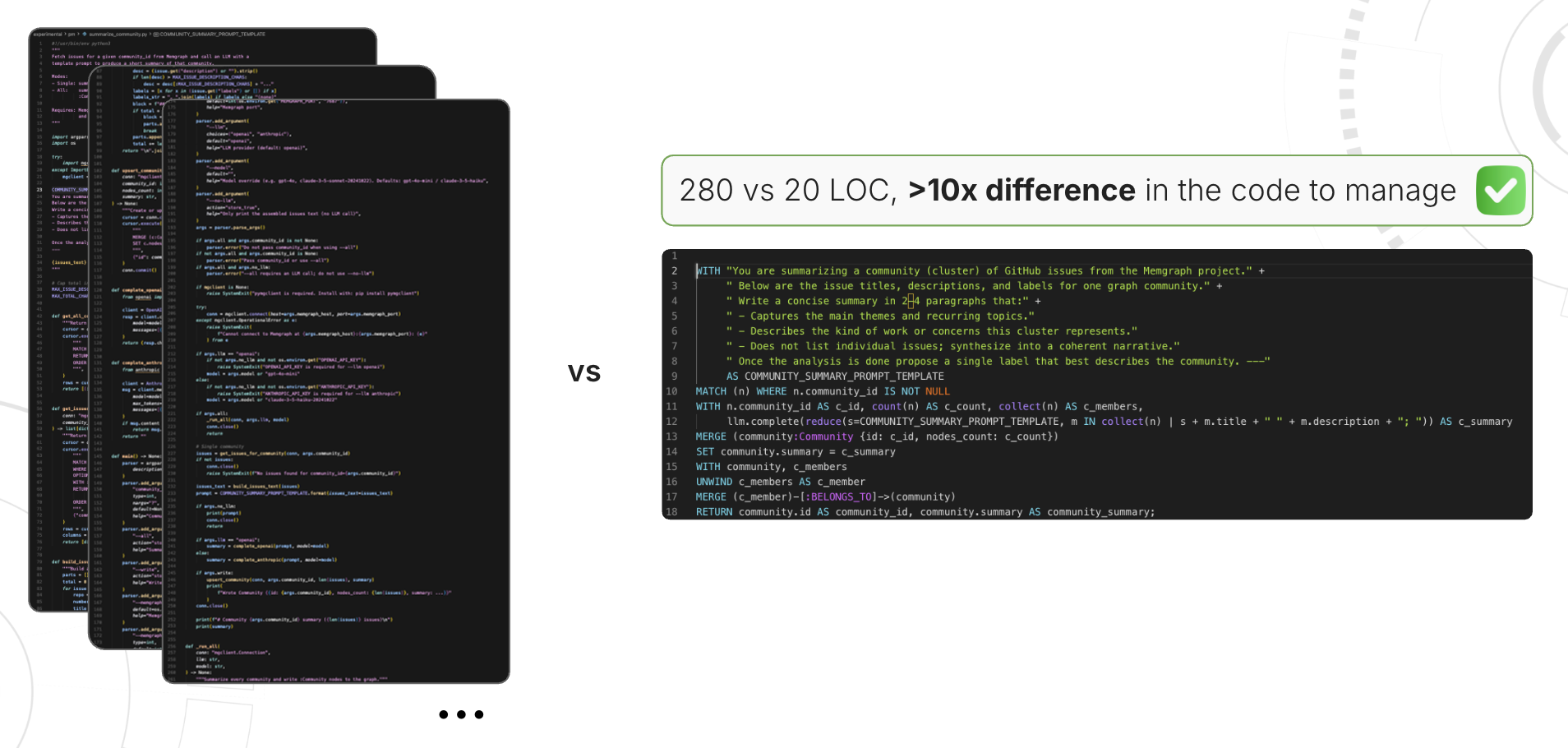
Text2Cypher is just one type of retrieval pattern it can handle. We will be showcasing the other types in future articles.
Read More: Atomic GraphRAG Explained: The Case for a Single-Query Pipeline
Text2Cypher Example 1: Amazon Reviews Knowledge Graph
This example comes from a knowledge graph built over 2023 Amazon Reviews dataset of 571M+ reviews.
A simple analytical question from the Amazon Reviews dataset is:
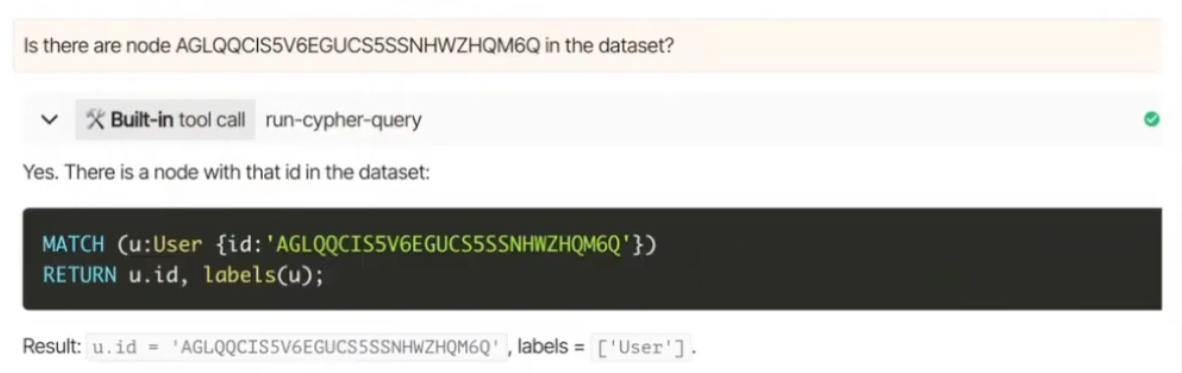
Is there node
AGLQQCIS5V6EGUCS5SSNHWZHQM6Qin the dataset?
The Atomic GraphRAG query for this example is:
SHOW SCHEMA INFO;

MATCH (u:User {id: 'AGLOOCISSV6EGUCSSSSNHWZHOM60'})
RETURN u.id, labels(u);
This example is intentionally simple. That is not a weakness but its characteristic. The question is asking for an exact lookup against the graph. The expected result is direct as well:
For full walkthrough, Watch the full Amazon Reviews demo!
Text2Cypher Example 2: GitHub Issues Knowledge Graph
A second analytical example comes from a graph built over Memgraph-owned GitHub issues.
In this setup, GitHub issues are connected not only through labels, but also through RelatedTo edges derived from entity extraction over issue titles and descriptions. One analytical question example from this dataset is:
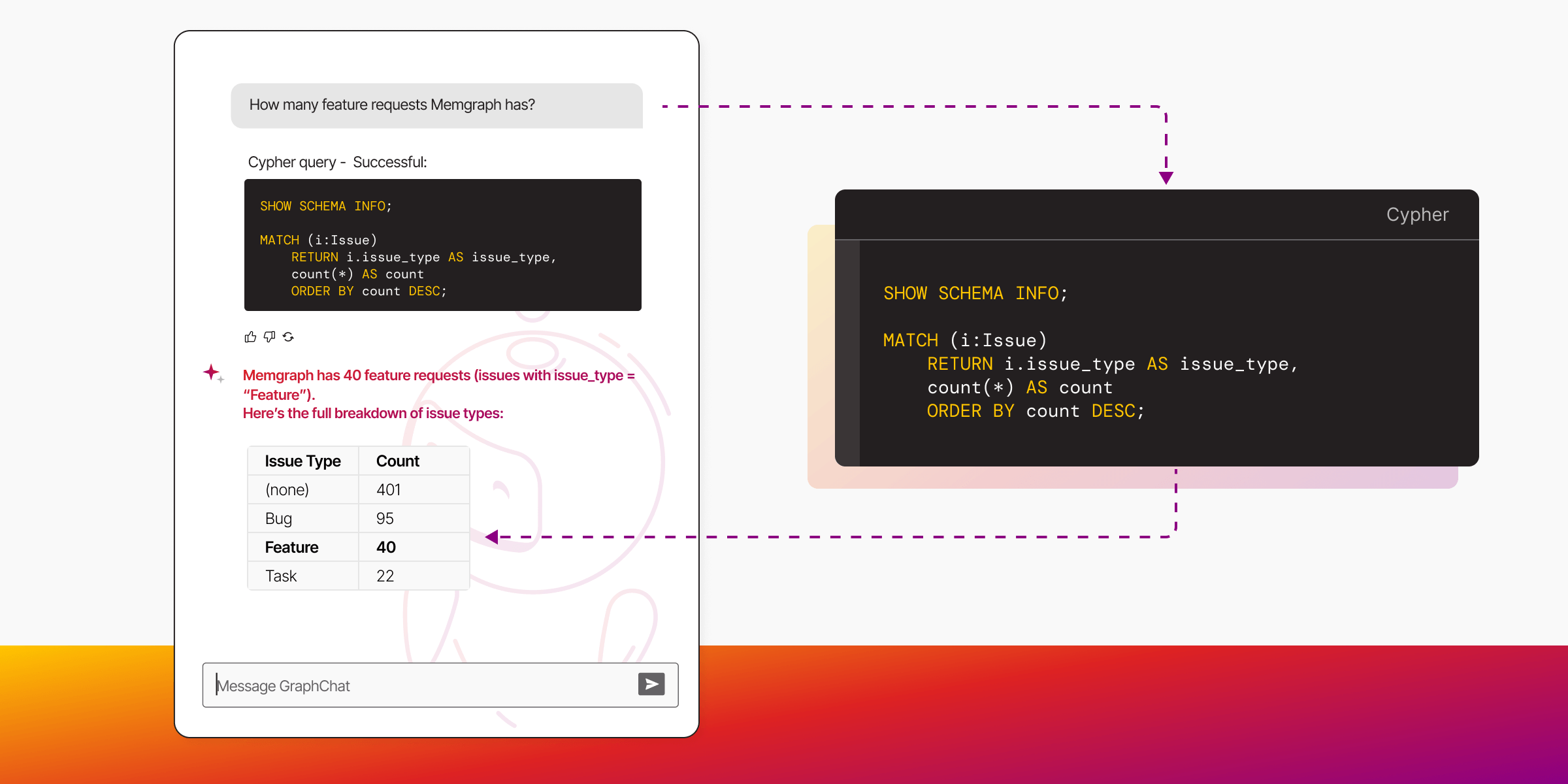
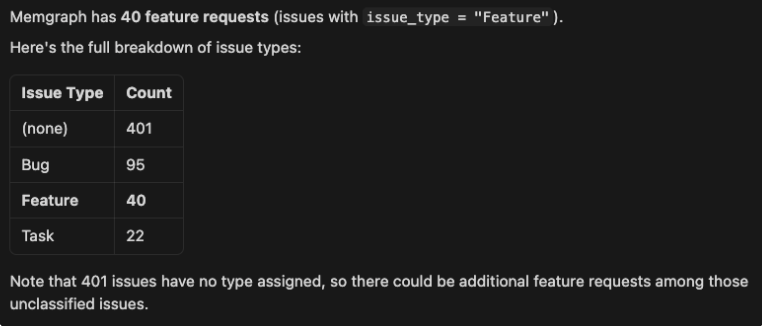
How many feature requests Memgraph has?
The query used for this example is:
SHOW SCHEMA INFO;

MATCH (i:Issue)
    RETURN i.issue_type AS issue_type,
    count(*) AS count
    ORDER BY count DESC;
Here, the result is table shaped.
For full walkthrough, watch the full GitHub Issues demo!
The Benefits of Atomic GraphRAG
Text2Cypher is a useful entry point into Atomic GraphRAG. Why? Because analytical questions are already relatively clean with short pipeline:
- inspect schema
- generate query
- run query
- return result
That is useful, but it does not fully show what happens when more retrieval logic is kept inside one query plan. The bigger payoff becomes easier to see in the other complex question types.
For local questions, the system may need to find a pivot node, expand to relevant neighbors, rank what matters, and return a compact context set.
For global questions, it may need to process a broader subgraph, group related parts, generate summaries, and synthesize an answer from that larger structure.
That is where Atomic GraphRAG becomes more visible as an execution model, because more of the retrieval plan can stay inside the database instead of being split across external code.
So Text2Cypher is best understood as the cleanest retrieval pattern in the set, not the full story.
When Not to Use Text2Cypher in GraphRAG
Text2Cypher is not the right fit for every GraphRAG question. It starts to break down when the question is open-ended, exploratory, or depends on pulling together broader context from multiple parts of the graph.
For example, this pattern is not the best fit for questions like:
- Why are users unhappy with this product?
- What themes show up across negative reviews?
- Which related issues are most closely connected to this issue?
Those questions usually need richer context, not just a direct structured query result. That is where local graph search, broader query focused summarization, or other retrieval pattern types become more appropriate.
Wrapping Up
Text2Cypher is the analytical side of GraphRAG that is a strong fit for lookups, counts, filters, and grouped outputs over structured graph data.
It is also a useful way to understand the foundation of Atomic GraphRAG. Start with the simplest question type, keep the retrieval step close to the graph, and let the structure of the question decide the structure of the pipeline.
The other question types build on that same idea, but with deeper, more complex retrieval steps.
If you build GraphRAG systems and you are tired of pipeline sprawl, explore Memgraph’s AI Ecosystem and our AI Toolkit.