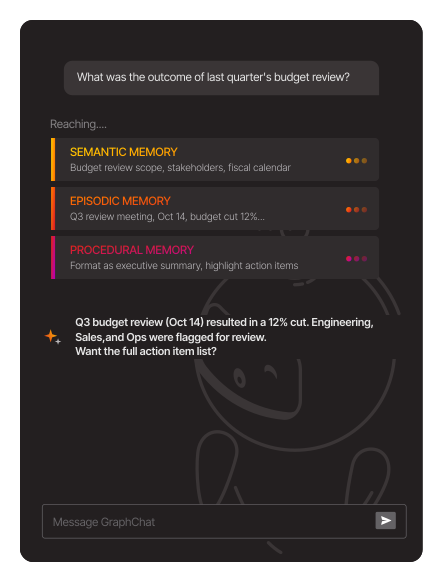
What the system knows.
Facts, preferences, entity knowledge. As a graph: entities with typed relationships - traversal, not similarity matching.
SHOW SCHEMA INFO returns the graph ontology in constant time.
Store, connect, and query three types of long-term memory, semantic, episodic, and procedural as a unified graph that any AI system can reason over in real time.
curl -sSL https://install.memgraph.com/ai-memory | bash
iwr https://install.memgraph.com/ai-memory/windows -useb | iex
Memgraph and MCP, pre-loaded with semantic, episodic, and procedural memory in one graph. Requires Docker and git; no API keys.
LLMs are stateless. Vector-based memory retrieves what sounds similar, not what's structurally relevant given the full history of interactions, preferences, and evolving state.
Facts, preferences, entity knowledge. As a graph: entities with typed relationships - traversal, not similarity matching.
SHOW SCHEMA INFO returns the graph ontology in constant time.
Past interactions with temporal context. As a graph: interaction nodes encoding sequence, causation, and consequence.
In-memory writes for live conversation. Retrieval via Agentic GraphRAG.
Workflows, escalation paths, decision trees. As a graph: steps as nodes, transitions as edges.
Graph of Skills models competencies, dependencies, and decay rates.
Semantic fact → episodic event → procedural response. That interconnection is a graph problem - multi-hop relationships between memory types that vector databases cannot represent.
Schedule a follow-up with the client like last time.
Done ✅ 30min Tuesday slot booked, invite sent.
Sub-millisecond traversals. Native vector search. Real-time writes. Built for AI pipelines that can't afford to wait.
Use Mem0 or Cognee with Memgraph as the graph backend. These tools handle entity extraction, memory management, and retrieval patterns. Memgraph stores the graph and serves queries.
Integrations: Mem0 · CogneeEnterprise memory requirements are specific to each organisation's data, workflows, and compliance constraints. Memgraph provides the engine for building custom memory systems on your own infrastructure.
Tools: Cypher · MAGE · MCP ServerEverything already included: the database, the sample data, and working examples. Spin up Memgraph and its MCP server, loaded with semantic, episodic, and procedural memory in one graph, ready to run. Requires Docker and git; no API keys.
Read detailed docscurl -sSL https://install.memgraph.com/ai-memory | bash
iwr https://install.memgraph.com/ai-memory/windows -useb | iex