Shortest path
Most efficient route to a goal.
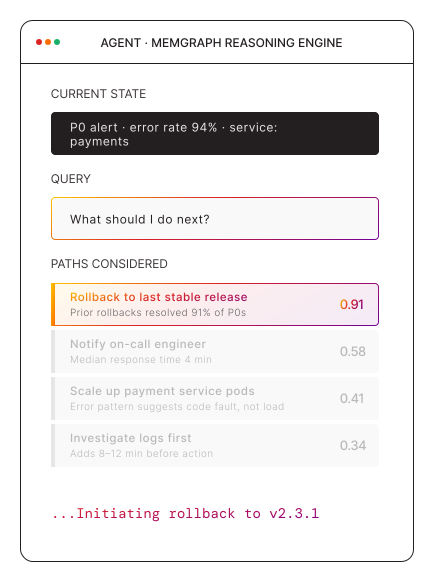
The core question for any agent is: what should I do next? A reasoning graph makes the answer explicit - queryable action space, scored paths, inspectable traces.
curl -sSL https://install.memgraph.com/agentic-ai | bash
iwr https://install.memgraph.com/agentic-ai/windows -useb | iex
Memgraph and MCP, pre-loaded with a reasoning graph and multi-agent shared state. Requires Docker and git; no API keys.
Most agent frameworks answer "what next?" by prompting the LLM to reason in natural language consuming tokens, producing variable results, and offering no guarantees. A reasoning graph makes the action space explicit and traversable.
Nodes represent states or decision points. Edges represent available actions. Properties encode scores, expected value, feasibility, historical success rate. The planning problem becomes a graph traversal.
Most efficient route to a goal.
Identify critical intermediate states worth validating.
Group related sub-tasks for parallel execution.
Evaluate multi-step plans without consuming LLM calls.

When the agent acts, the traversed path is an inspectable trace. Alternative paths can be scored and compared. The basis for the decision is examinable through graph structure and edge scores, not through interpretation of token probabilities.
Sub-millisecond traversals. Native vector search. Real-time writes. Built for AI pipelines that can't afford to wait.
Memgraph toolkit with 7+ tools for building stateful, multi-actor agent applications with graph-backed state management.
Read docsConnect any MCP-compatible client - Claude, VS Code, custom agents, directly to Memgraph for Cypher queries and graph analysis.
Read docsConnect Memgraph Lab to external MCP servers - Stripe, Elasticsearch, Slack, and others, to combine graph insights with live data from across your stack.
Read docsEverything already included: the database, the sample data, and working examples. Spin up Memgraph and its MCP server, loaded with a reasoning graph and multi-agent shared state, ready to run. Requires Docker and git; no API keys.
Read detailed docscurl -sSL https://install.memgraph.com/agentic-ai | bash
iwr https://install.memgraph.com/agentic-ai/windows -useb | iex