USER STORY
How Cedars-Sinai Uses Memgraph for Knowledge-Driven Machine Learning in Alzheimer’s Research

User
Cedars-Sinai Medical Center
Industry
Biomedical Research
Profile
Automated Machine Learning
Challenge
Integrate complex biomedical data for Alzheimer’s research into a machine learning pipeline that could deliver accurate, context-aware predictions.
Solution
Cedars-Sinai internally developed KRAGEN and ESCARGOT on top of Memgraph graph database to enhance accessibility and precision in querying and analysis.
Reading time: 7min
About Cedars-Sinai
Cedars-Sinai is a leading non-profit academic healthcare organization known for its advanced biomedical research and innovation, committed to pushing the boundaries of medical science and improving patient outcomes worldwide.
Jason H. Moore, PhD, FACMI, FIAHSI, FASA, is an accomplished computational biologist and expert in artificial intelligence applications in medicine. As the Chair of the Department of Computational Biomedicine and the Director of the Center for Artificial Intelligence Research and Education at Cedars-Sinai Medical Center, Dr. Moore leads innovative research at the intersection of AI, machine learning, and healthcare.
Jason H. Moore, PhD, FACMI, FIAHSI, FASA, is an accomplished computational biologist and expert in artificial intelligence applications in medicine. As the Chair of the Department of Computational Biomedicine and the Director of the Center for Artificial Intelligence Research and Education at Cedars-Sinai Medical Center, Dr. Moore leads innovative research at the intersection of AI, machine learning, and healthcare.
Impact highlights
Enhanced predictive accuracy
The knowledge graph enriches the AutoML pipeline, leading to better Alzheimer’s risk predictions and more effective drug discovery.
Data-driven insights
Supports complex queries across genomic data, clinical trials, and patient records, facilitating faster insights and hypothesis generation.
Improved reasoning
System testing revealed remarkable improvements, with ESCARGOT achieving a 94.2% accuracy rate for multi-hop reasoning—far exceeding ChatGPT’s standalone performance of 49.9%.
"Performance has been very good—answers return within seconds. So far, performance hasn't been an issue. Having Memgraph as an in-memory graph database certainly speeds up the Cypher queries ESCARGOT performs on the fly."
Jason H. Moore, Chair of the Department of Computational Biomedicine

Backstory
With Alzheimer’s disease on the rise, costing the U.S. economy over $360 billion annually, Jason Moore’s team at Cedars-Sinai started building advanced AI to predict risk and discover new drugs for Alzheimer’s. This required combining diverse biomedical data—genetic, genomic, imaging, and clinical information—into one machine learning (ML) system. But traditional ML methods lack critical disease context, often blindly searching for patterns without understanding genetic, biochemical, or clinical relationships in Alzheimer’s.
Challenge
Integrating large-scale, complex biomedical datasets to support Alzheimer’s research and to optimize AutoML-driven predictive modeling and drug discovery.
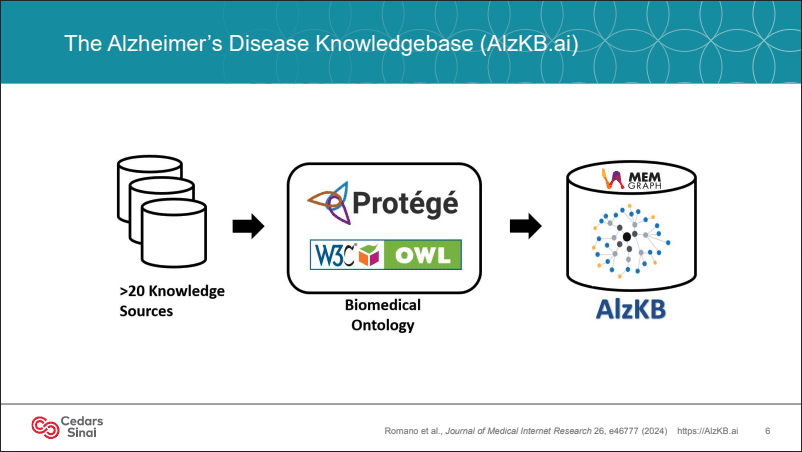
To work on this Alzheimer’s disease research, Jason’s team built the Alzheimer’s Disease Knowledge Base (AlzKB), using Memgraph as the graph database. This knowledge graph integrates over 20 biomedical sources, covering genetic, drug, and disease relationships through a comprehensive ontology. This gives background information to ML.
Now, Jason’s team originally started working on their project using Neo4j, but transitioned to Memgraph for better performance and licensing flexibility.
To make AlzKB accessible to non-technical users, they integrated GPT, but quickly realized standard LLMs struggled with complex medical queries. They then developed KRAGEN—a knowledge graph-enhanced RAG (Retrieval-Augmented Generation) system—tailored for Alzheimer’s. KRAGEN encodes graph data into vectors, enabling LLM to generate contextually accurate responses by drawing directly from AlzKB’s structured knowledge.
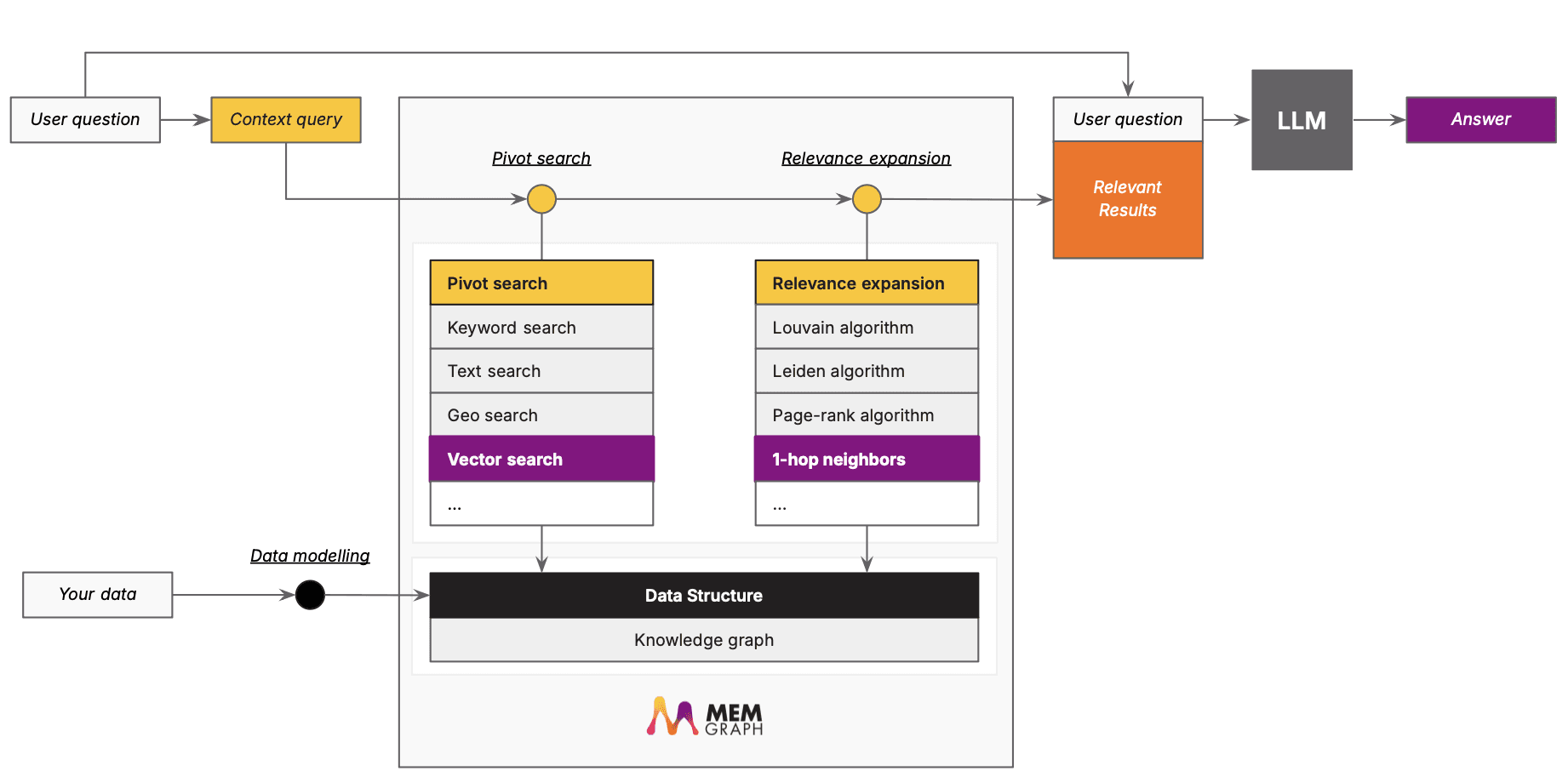
Here’s how the GraphRAG implementation looks like from the Memgraph stack perspective:
Now, Jason’s team originally started working on their project using Neo4j, but transitioned to Memgraph for better performance and licensing flexibility.
To make AlzKB accessible to non-technical users, they integrated GPT, but quickly realized standard LLMs struggled with complex medical queries. They then developed KRAGEN—a knowledge graph-enhanced RAG (Retrieval-Augmented Generation) system—tailored for Alzheimer’s. KRAGEN encodes graph data into vectors, enabling LLM to generate contextually accurate responses by drawing directly from AlzKB’s structured knowledge.
Here’s how the GraphRAG implementation looks like from the Memgraph stack perspective:
Why Memgraph?
- Performance
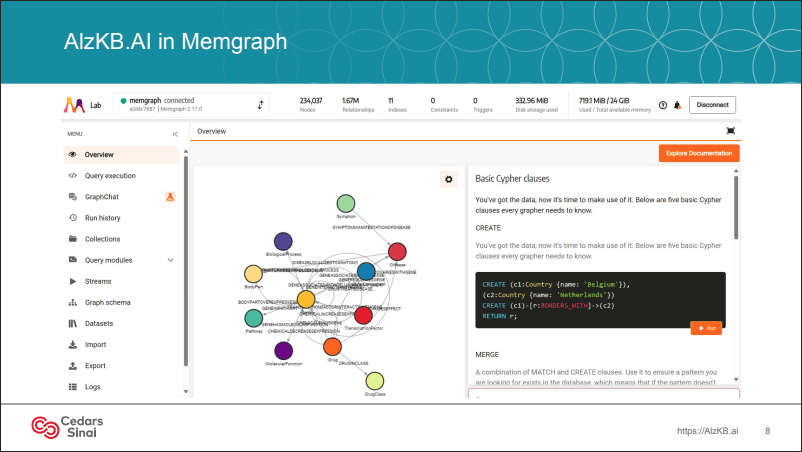
- Jason’s team experienced a boost in performance with Memgraph, which was essential for handling complex queries efficiently, especially given the large-scale data in the Alzheimer’s Disease Knowledge Base (AlzKB), which contains over 234,000 nodes and 1.67 million edges.
- Favorable licensing
- Neo4j’s aggressive licensing tactics and sales approach were deterrents for Jason’s team. Memgraph offered a more favorable licensing environment, allowing them to scale and deploy the knowledge graph more freely.
- Cypher compatibility with Neo4j
- Memgraph’s support for Cypher, the same query language used by Neo4j, allowed the team to migrate seamlessly and continue using their existing knowledge without retraining or re-coding.
How Memgraph Works With Their Internal Tools and Methods
KRAGEN, AlzKB, and Memgraph together power the automated ML pipelines that Jason’s team uses to predict Alzheimer’s risk and identify potential drug candidates. KRAGEN combines semantic relationships within AlzKB with large language models (LLMs), allowing nuanced question-answering. With Graph of Thoughts (GoT), another tool integrated into the system, compound questions are split into manageable parts, which the ML models answer before combining for a final response.
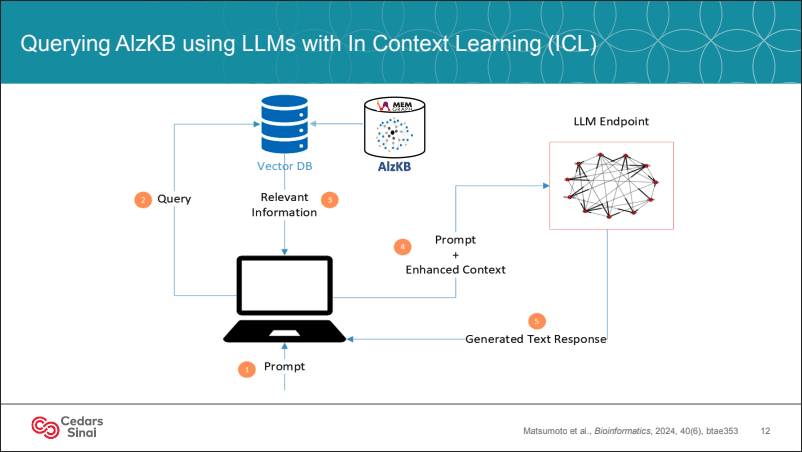
To tackle compound queries—such as “Which genes are associated with Alzheimer’s and affected by FDA-approved drugs?”—KRAGEN uses a structured, multi-step approach:
- Vectorization: Encodes graph entities as numeric vectors in Memgraph’s database.
- RAG Process: Retrieves relevant vectors for user queries, giving GPT the contextual knowledge needed to answer Alzheimer’s-specific questions.
- Graph of Thoughts: Breaks down compound questions, analyzing different facets of a query to deliver accurate, composite answers.
To further enhance accuracy, Jason’s team developed ESCARGOT, an AI agent with dynamic Graph of Thoughts capabilities that generates Cypher queries in real time. ESCARGOT enables on-the-fly decomposition of complex queries, dynamically retrieving data from Memgraph for precise, compound answers.
"Essentially, ESCARGOT makes the 'graph of thoughts' process more dynamic. It breaks down the query into components and then generates Python code to execute a Cypher query directly in Memgraph, bypassing the vector database and RAG approach."
Jason H. Moore, Chair of the Department of Computational Biomedicine
Results
- Repurposing drugs. By guiding machine learning toward unexplored gene and drug connections, the team identified potential Alzheimer’s therapies, including Temazepam and Ibuprofen.
- Interactive data science assistant *coming soon. Cedars-Sinai’s prototype allows researchers to interactively analyze Alzheimer’s data. Users can issue conversational commands to access genetic data, generate datasets, and perform ML tasks without coding.
Continue reading our customer stories
Let's see how Memgraph fits into your environment