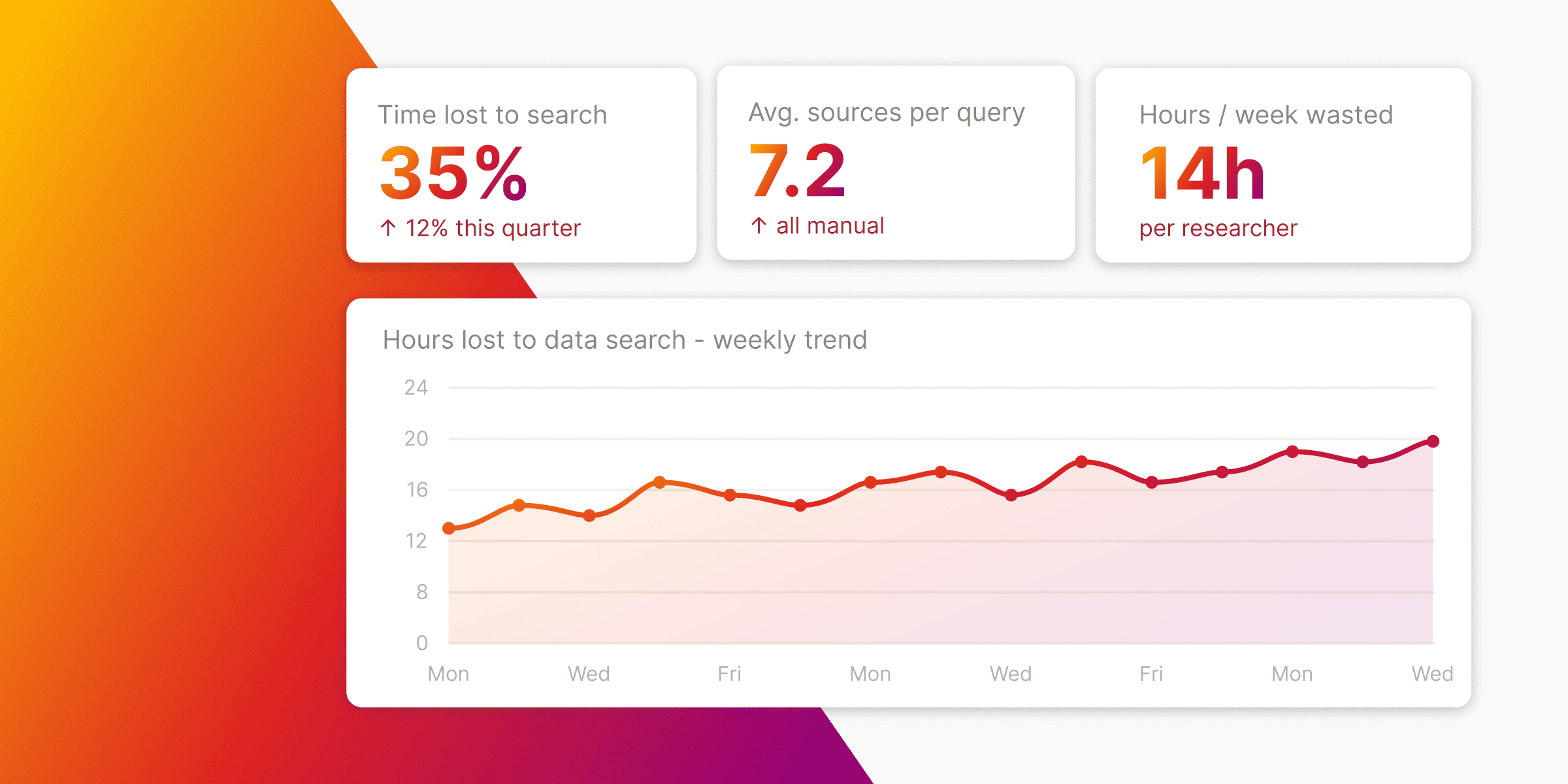
Researchers in Biotech Lose 30% to 40% of Their Time Searching for Data
Drug discovery teams do not lack information. They lack a knowledge layer that connects it across sources.
Scientists already have access to more genomic, proteomic, clinical, and literature data than ever before. The real problem is that this information exists in fragments. When the answer to one research question requires connecting a gene variant in one system to a protein pathway in another, a compound library in a third, and prior findings in the literature, the work slows down fast.
McKinsey has reported that data users can spend between 30% and 40% of their time searching for data when there is no clear inventory of what is available. In drug discovery, that directly affects how quickly teams can evaluate and refine a hypothesis.
The Real Bottleneck Is Retrieval
Many discovery organizations still frame the problem as one of scale. Too many papers. Too many assays. Too many medical datasets. Too many internal systems. That diagnosis is incomplete.
A principal scientist does not need all available information at once. They need the right chain of evidence for the question in front of them. Which proteins sit in this pathway? Which compounds already target them? What disease associations exist in the literature? Are there clinical observations or safety signals that change the picture?
These are not single-source questions. They require a knowledge graph or another structured layer that can connect the evidence across sources.
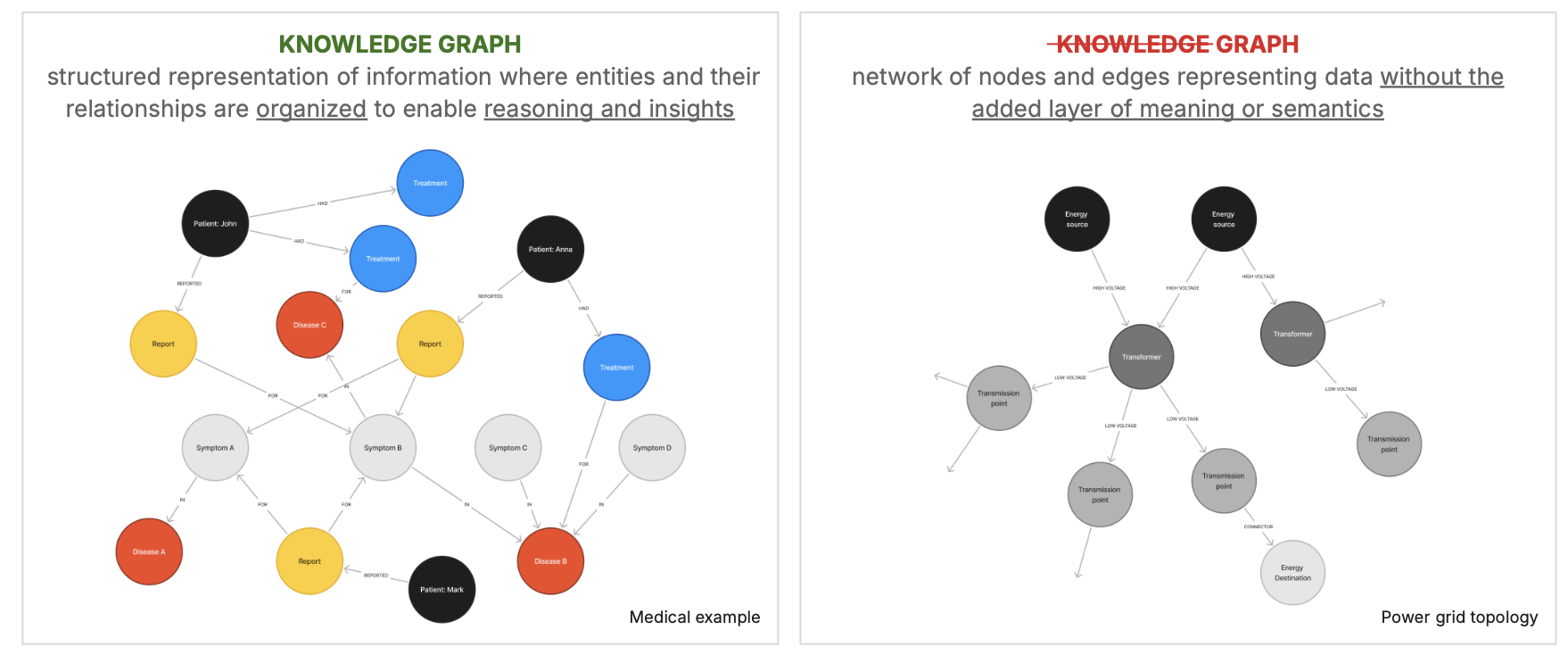
That is why teams can invest heavily in data infrastructure and still move more slowly than expected. More repositories do not automatically mean faster research. In many cases, they just create more places to search.
The Fragmented Map of Modern Research
Biomedical data is inherently relational, but the systems storing it are often isolated.
A typical research workflow may cut across PubMed, internal white papers, LIMS, pathway databases such as Reactome, protein resources such as UniProt, compound libraries such as ChEMBL, clinical records, and patent filings. Each source contributes part of the picture. None holds the whole context.
When a researcher asks a question such as, “Which compounds target proteins in this inflammatory pathway and also show up in our recent assay results?”, they are not asking for one row in one table. They are asking for a multi-step path across several domains.
Because those sources are rarely connected through a usable knowledge graph, the researcher becomes the bridge. They export results from one system, normalize identifiers in a notebook, search another database, compare findings against a third source, and manually decide whether the evidence lines up.
Why Search Time Turns Into Discovery Delay
Poor retrieval slows research in predictable ways.
Researchers spend time assembling context that should already be queryable. Teams repeat work when prior findings are hard to find. Confidence also drops when evidence is scattered across disconnected systems and no one is sure if the picture is complete.
This pattern shows up outside research environments too. Adobe reported in 2023 that 48% of surveyed workers had trouble finding documents quickly, while 47% said their company’s filing systems were confusing or ineffective. In R&D, that same retrieval friction is harder to absorb because answering one question often means pulling evidence from several systems, not just locating one file.
The Cost of Missed Connections
The obvious cost of poor retrieval is lost time. The more serious cost is what stays out of view. When information stays siloed, researchers only see the relationships they are already looking for. They miss connections between targets, pathways, compounds, phenotypes, side effects, and prior evidence.
This is hard to measure because the missed insight leaves no clean trail. You do not see the answer you failed to find. You see slower progress, lower confidence, or a promising direction that was never pursued.
That is why information fragmentation is not just a data management problem. It is a scientific discovery problem.
You can see this in real research settings. In Alzheimer’s research, Cedars-Sinai built the Alzheimer’s Disease Knowledge Base to connect more than 20 biomedical sources across genetic, drug, and disease relationships.
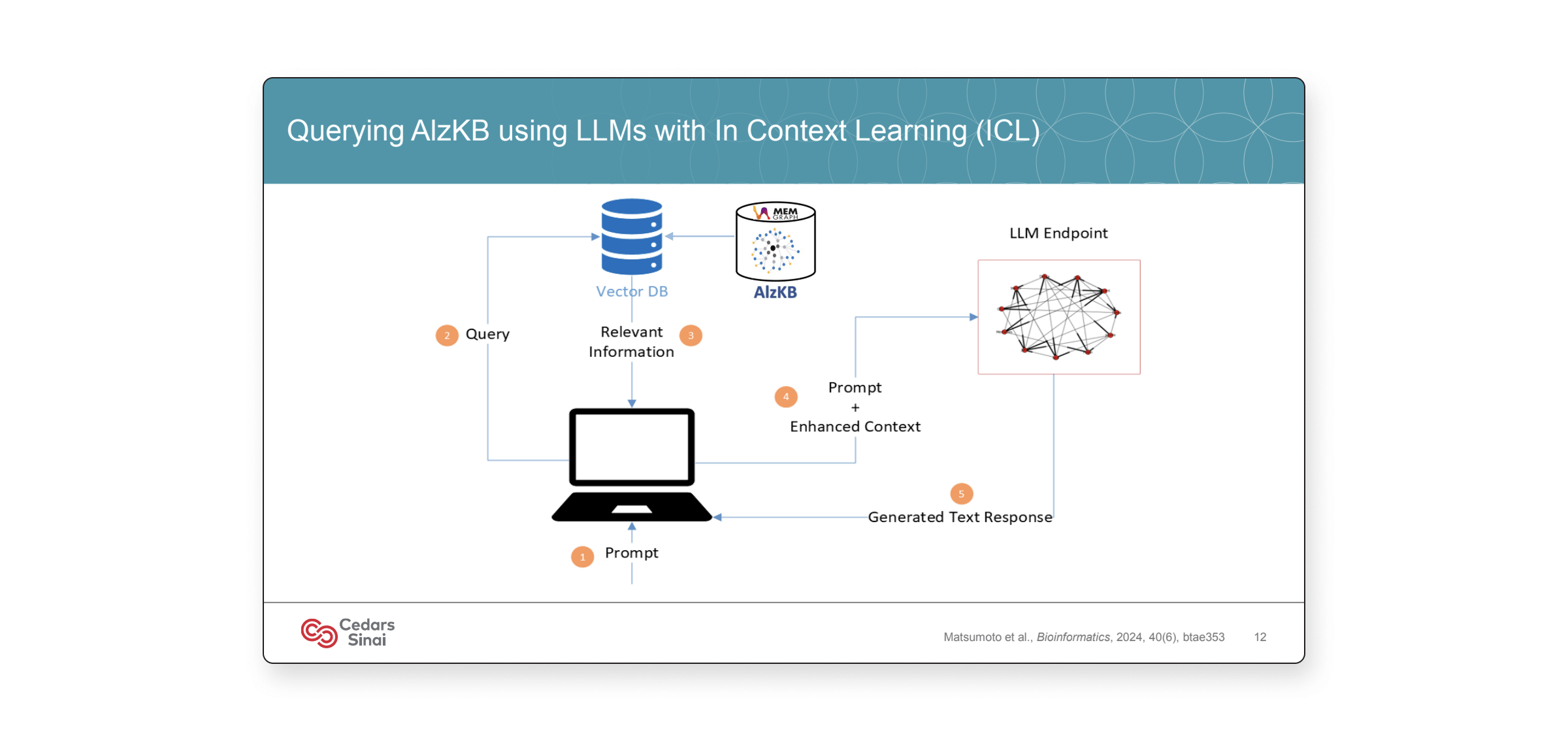
Their team then built question-answering workflows on top of that knowledge graph after finding that standard LLMs struggled with nuanced medical queries. The result was not just better access to information. It supported faster hypothesis generation, more accurate multi-hop reasoning, and the identification of potential therapies such as Temazepam and Ibuprofen.
Why This Problem Hits Pharma and Biotech Harder
Pharma and biotech teams face a sharper version of this problem because the domain itself is relational.
Genes interact with proteins. Proteins participate in pathways. Pathways are implicated in diseases. Compounds act on targets and off-targets. Clinical outcomes sit alongside molecular context. Patent activity can change the value of a finding.
At the same time, the source landscape keeps expanding. External knowledge bases evolve constantly. Internal systems use different schemas and naming conventions. Literature adds unstructured evidence. Teams across biology, chemistry, translational research, and informatics each hold part of the picture.
This is where a knowledge graph becomes useful. It makes those relationships explicit instead of leaving researchers to reconstruct them by hand.
What Researchers Actually Need
Another dashboard is rarely the answer. Adding one more interface on top of the same fragmented environment may make search look cleaner, but it does not fix the underlying issue. Discovery work is not just keyword retrieval. Researchers often start with a partial idea and need to move through related evidence, not just find one matching term.
In practice, that means being able to ask a question once and follow the relevant chain of entities, evidence, and dependencies without manually stitching the context together first. In many research settings, that requires a knowledge graph that can represent entities, relationships, and provenance in one structure. This does not replace scientific judgment. It removes low-value work that gets in the way of it.
What Better Retrieval Looks Like With a Knowledge Graph
A better retrieval model should follow how scientists actually work. In drug discovery, that often means using a knowledge graph to support multi-step retrieval across entities and evidence.
Researchers move from disease to pathway, from pathway to target, from target to compound, and from compound to supporting evidence. As the question changes, the retrieval path changes with it.
A knowledge graph-based retrieval layer should make it easier to:
- move across entities instead of staying trapped in one source
- trace where each finding came from
- compare evidence from literature, internal data, and reference databases in one flow
- ask multi-step scientific questions without manually joining the context first
- revisit prior work without repeating the search from scratch
Discovery Moves Faster When Context Is Connected
Drug Discovery teams invest heavily in computation, modeling, and automation. But those investments are weaker when researchers cannot reach the full context of what the organization already knows.
The bottleneck is often not raw compute. It is whether a researcher can move from scattered facts to connected evidence fast enough to make sound decisions. That is the shift more drug research organizations need to make. Retrieval should be treated as part of the scientific workflow itself.
When researchers spend a third of their time searching for information that already exists, the cost is delayed discovery.
Further Reading
- Success Story: How Cedars-Sinai Uses Memgraph for Knowledge-Driven Machine Learning in Alzheimer’s Research
- White Paper: How Graph-Powered AI Is Accelerating Discovery and Care in Healthcare and Biotech
- Success Story: Memgraph and GraphRAG: Transforming Diabetes Management in Healthcare
- Blog: How Can GraphRAG Speed Up Drug Discovery and Safety