Fraud Is a Relationship Problem, Not a Data Volume Problem
Fraud teams rarely fail because they cannot process enough data. They fail because the data is split into isolated events.
A payment can look ordinary on its own. The amount is normal. The customer has a history. The destination account is not brand new. The device fingerprint is not obviously risky. A transaction-level model may let it pass. That is exactly what the problem is.
Coordinated fraud rarely appears as one extreme transaction. For instance, in cases such as authorized push payment fraud, the payment itself can look legitimate even when the surrounding network is not. It appears as a pattern across entities that look harmless in isolation but suspicious in combination. Shared addresses. Reused devices. Accounts one or two hops away from known mule networks. Small transfers moving through the same intermediaries.
This is not a small edge case. In its Annual Fraud Report 2025, UK Finance reported £1.17 billion in total fraud losses in 2024. Authorized fraud alone accounted for £450.7 million in losses. Financial institutions already have plenty of data. The issue is that much of the fraud stack still treats detection as a row-level classification problem when the real signal often sits in the network.
Why Transaction-Level Fraud Detection Falls Short
Most production fraud models are built on tabular features. That makes sense for many tasks. You can score amount, velocity, merchant type, geography, time of day, device changes, chargeback history, customer tenure, and hundreds of other signals. Those features are useful. They just are not enough.
A tabular model asks a narrow question: what does this event look like based on the fields attached to it?
Fraud rings exploit that boundary. They spread activity across accounts, identities, devices, addresses, and time windows so that no single event looks extreme enough to trigger action. The structure carries the signal, not the single row.
That is why teams keep seeing the same painful pattern. A suspicious case gets confirmed. Investigators dig deeper. Then they discover the real issue was not one payment. It was a connected cluster they could only see after the fact. By then, the damage has already spread.
What Tabular Models Miss
Imagine a payment of $480 from a customer account that has been active for years.
Nothing about the transaction looks alarming. The amount is plausible. The transfer falls within the customer’s normal range. The destination account is domestic. The session was authenticated properly. A tabular model might score it as low risk.
Now add the missing context.
The sender shares a mailing address with three accounts flagged in the past month. The destination account received funds from a known mule account two days earlier. One of the sender’s devices has also appeared on an account tied to a prior fraud investigation. Two hops out from the destination account, the funds lead into a small cluster that keeps appearing in past scam cases.
The payment did not become risky because the transaction changed. It became risky because the surrounding network changed what the transaction meant.
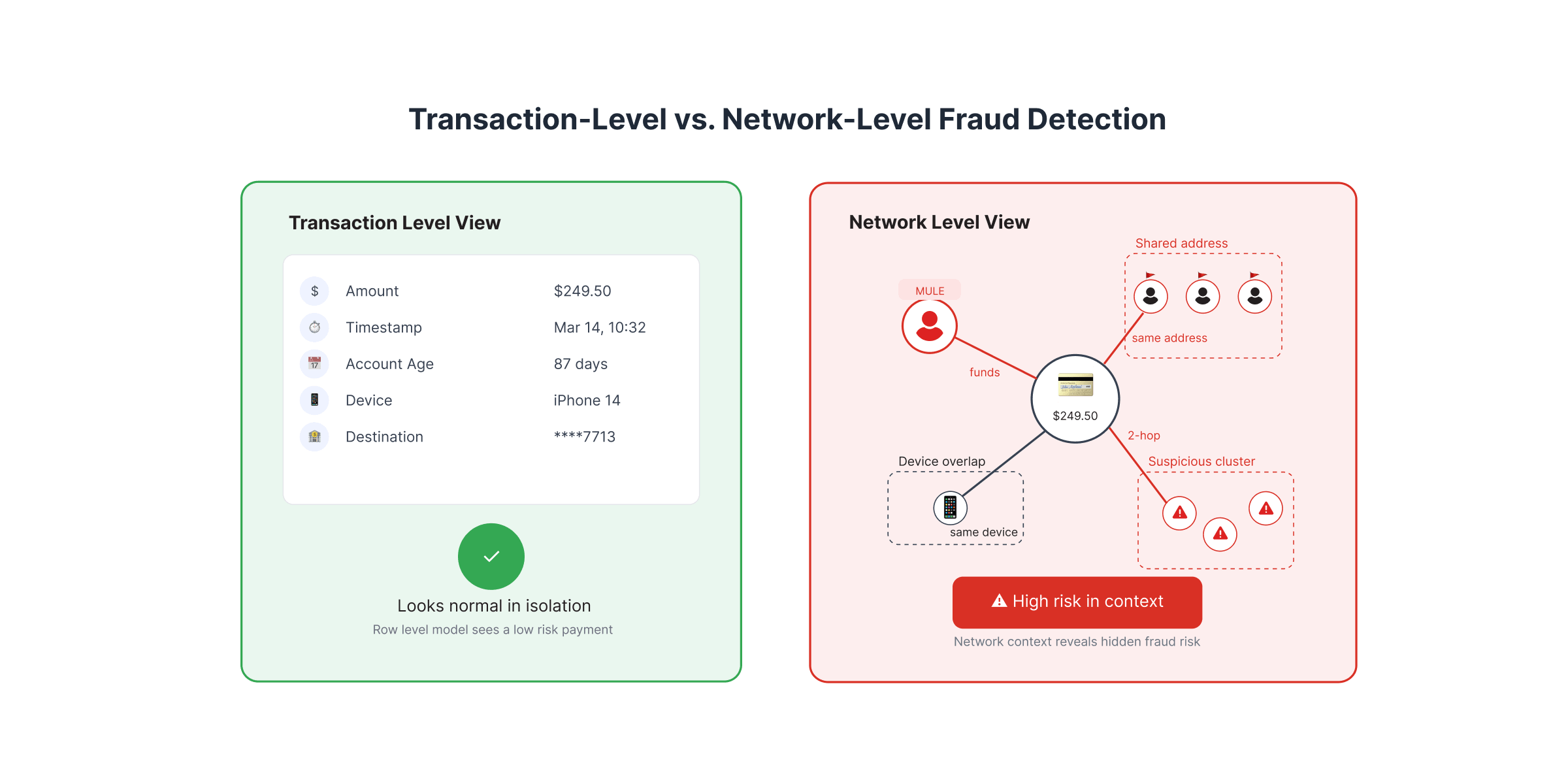
That is the core limitation of row-by-row detection. It evaluates an event without enough knowledge of the neighborhood around it.
Coordinated Fraud is Relationship-Based
This is where many fraud strategies break down.
Fraud operations are not random collections of bad transactions. They behave more like adaptive systems. A scammer tests a path, rotates accounts, reuses a phone number, shifts to a fresh device, or inserts an intermediary account to create distance from known flags. One part of the pattern changes. The rest stays connected.
That is why the most important signals in fraud are often relationship-based. You are not just asking whether a payment is suspicious. You are asking questions like these:
- Is this account connected to previously flagged entities through one or two intermediaries?
- Are multiple identities converging on the same beneficiary?
- Are small, low-risk-looking transfers forming a repeated route through the same network?
- Is this device appearing across accounts that should not overlap?
- Is a new account inheriting a suspicious neighborhood even if its own history looks clean?
Those are not volume questions. They are relationship questions. And relationship questions are hard to answer in systems designed to inspect one record at a time.
Why More Data Does Not Fix the Blind Spot
A common response to missed fraud is to add more features, more history, or more model complexity. That can help at the margin. It does not solve the structural issue. If the model still learns from flattened events, it still has to compress connected behavior into indirect proxies. You end up hoping enough engineered columns will approximate the network.
That is why mature fraud programs still miss coordinated activity. The blind spot is not weak modeling. It is the wrong representation of the problem.
The challenge wrongly looks like one of scale. It is really one of structure.
What Network-Level Detection Sees That Tables Do Not
A network view changes the unit of analysis. Instead of looking only at the transaction, you look at the transaction inside a web of entities and relationships. Accounts connect to devices, sessions, IP ranges, addresses, beneficiaries, and other incoming and outgoing flows.
That changes the questions you can ask. Does a normal-looking payment sit inside a suspicious pattern? Are multiple low-risk actions converging on the same node? Is risk isolated, or spreading through a cluster?
This is where coordinated fraud starts to surface. Not because one transfer suddenly looks outrageous, but because the network reveals repeated structure, shared infrastructure, and suspicious proximity. A recent review of graph neural networks for financial fraud detection reaches a similar conclusion: relational structure often captures signals that flat representations miss.
Why One Hop Is Rarely Enough
Many teams do some form of linked analysis already. They check for direct overlaps such as shared phone numbers, shared devices, or known counterparties.
That is useful. It is also limited. The real signal often appears one or two steps beyond the obvious match.
A direct connection tells you this account touched something suspicious. A second hop can tell you whether that touch was incidental or part of a recurring structure. It can reveal shared intermediaries, repeated fund movement routes, and clusters that do not show up in first-degree lookups. That is a critical distinction in financial crime.
The strongest fraud patterns are often not direct repeats. They are partial reassemblies of prior networks. The same actors adapt. The same infrastructure gets recycled. The same routes reappear with different surface details.
If your detection logic stops at the first visible connection, you will catch some cases and still miss the system behind them.
Why This Matters in Production
When models miss relationship-level patterns, fraud teams pay twice. First, they miss coordinated attacks that should have been caught earlier. Second, investigators end up reconstructing the network manually after an alert fires.
That is the tell. If analysts keep drawing case maps after the model scores the transaction, the system is admitting that the important reasoning happened outside the model.
A network-aware approach improves both. It gives models better candidate signals and gives analysts clearer context for triage and explanation. In regulated environments, that matters. Teams need more than a score. They need a defensible reason for why a case looks suspicious.
What Relationship-Aware Fraud Detection Actually Requires
This does not mean throwing away tabular ML. Transaction features still matter. Behavioral features still matter. Historical features still matter. The problem is treating them as the whole picture.
A stronger approach combines event-level scoring with relationship-aware context. That usually means three things:
- Keep the transaction-level features that already work.
- Add connected signals that capture proximity, shared infrastructure, path behavior, and cluster-level risk.
- Let investigators move from an alert to the surrounding network fast enough to act on it.
That is how you stop forcing fraud teams to choose between scalable models and meaningful context. You need both.
The Real Shift: From Volume Thinking to Structure Thinking
Many fraud teams are dealing with a challenge shaped by growth. More customers. More payments. More channels. More fraud attempts. All true.
But the reason detection fails is usually not raw volume. It is that fraud behavior is coordinated, connected, and adaptive while the detection stack is still optimized for isolated events.
Once you see fraud as a relationship problem, a lot of things become easier to explain. Why a normal-looking payment can still be dangerous. Why false negatives cluster around networks rather than transactions. Why investigators keep drawing maps to understand cases. Why second-order connections matter.
The issue is not that there is too much data. It is that the fraud is connected and the detection logic often is not. If you want to catch coordinated fraud earlier, stop asking only whether a transaction looks suspicious on its own. Start asking what it is connected to.