Why Siloed Fraud Detection Systems Miss Organized Fraud Rings
Fraud detection has a visibility problem. Most financial institutions are built to answer narrow questions well. Is this transaction suspicious? Is this login risky? Should this claim be reviewed? Those are useful questions, and modern fraud systems have become very good at answering them.
But organized fraud does not operate as a single event.
Fraud rings spread activity across accounts, channels, products, and entities so that each individual step looks ordinary or only mildly suspicious. One team sees the login anomaly. Another sees the payment. Another sees downstream movement later in an AML workflow. Another sees a claim or payout that feels off but not clearly connected.
Each system may be functioning as designed. The problem is that the real pattern lives in the relationships between those events. That is the gap organized fraud exploits.
The Real Blind Spot Is Between Systems, Not Just Inside Models
Most institutions do not run one fraud system. They run several.
Payment fraud, AML, account takeover, onboarding risk, and claims investigations are often handled by different teams, with different tools, thresholds, data models, and review processes. That structure is understandable. Different fraud types have different operational requirements, and teams specialize for good reasons.
The problem is that organized fraud does not respect those boundaries.
A fraud ring can start with a synthetic identity, move through a compromised account, distribute funds through mule accounts, and surface again later through suspicious beneficiaries, policy activity, or downstream laundering behavior. Each team may catch a legitimate signal inside its own workflow. Yet no one sees enough of the chain early enough to understand the operation as a whole.
That is the real blind spot.
The stakes are not theoretical. The Financial Times reported a sharp rise in identified money mules in the UK, based on Financial Conduct Authority data. That matters because mule accounts are often what connect the initial compromise, the movement of funds, and the downstream laundering behavior that separate fraud systems review in pieces.
The weakness is not that individual models are useless. It is that each model is asked to judge a fragment of behavior that was intentionally designed to look incomplete when viewed alone.
A Simple Cross-System Fraud Scenario
Consider a simplified fraud-ring scenario inside a retail bank.
One account is opened using a synthetic identity. Nothing in the onboarding workflow looks severe enough to trigger immediate action.
A week later, a different customer experiences suspicious login recovery activity, but the account takeover signals remain below the threshold for escalation. Shortly after that, funds move in several small payments to accounts that do not yet look risky in a payment-fraud queue.
Later, part of that money is routed through intermediary accounts and ends up in a pattern that draws AML attention.
Now zoom out.
The synthetic identity from onboarding connects to infrastructure that also appears in the later payment activity. The suspicious login recovery links to one of the same beneficiary paths. The mule accounts sit between both.
The AML team eventually sees unusual movement, but by then the earlier indicators have already been treated as low-priority or isolated noise. Nobody was necessarily wrong. Each team made a reasonable judgment based on the local evidence it had.
The ring wins because the institution reviewed the behavior by function while the fraud operation behaved as one connected system.
Why Separate Models Create False Confidence
This is where the problem becomes more subtle.
A financial institution can have strong models in each domain and still miss organized fraud. The payment fraud model may be accurate. The account takeover model may be well tuned. The AML system may detect suspicious movement later in the chain.
That still does not guarantee good coverage against a coordinated network.
Fraud rings benefit when detection is divided into specialized systems that do not share enough context. That broader pattern is consistent with the FATF’s work on illicit financial flows from cyber-enabled fraud, which describes how criminals use money mules, intermediaries, and multi-stage movement of funds to obscure the full network. They do not need every event to look legitimate. They only need each event to look explainable inside the narrow boundary of the system reviewing it.
That creates false confidence.
Teams see decent model performance inside separate queues and assume the broader detection picture is healthy. In reality, the organization may be excellent at scoring fragments and weak at identifying the structure connecting them.
Why Multi-Hop Analysis Still Matters
This is where the problem becomes more operational.
Most machine learning pipelines in fraud still rely heavily on tabular representations. Teams flatten shared devices, beneficiaries, addresses, or counterparties into engineered features.
Those features can be useful, but they are usually local.
They tell you whether one entity connects directly to another. They do not naturally capture how risk propagates across two, three, or more hops through a network that cuts across multiple workflows.
That matters because some of the most useful fraud signals sit beyond direct neighbors.
A payment that looks mild in isolation may connect two hops away to the same intermediary or destination account that appears in other suspicious clusters. A beneficiary that seems ordinary in one queue may become high risk once you follow the surrounding paths across related accounts and prior cases.
At that point, the limitation is no longer just model quality.
It is that complex relationship analysis becomes harder to express, harder to maintain, and harder to run fast when everything has to be flattened back into rows. That broader limitation is also well established in the technical literature on graph-based anomaly and fraud detection, which focuses on patterns that only emerge when entities and their connections are analyzed together.
This is exactly why multi-hop analysis matters in real fraud work.
At Capitec, South Africa’s largest retail bank, the fraud team built a graph-powered scoring pipeline for authorized push payment fraud. The team found that looking two hops or more away revealed common fraudsters between clusters that would otherwise remain hidden.
Their broader production setup used graph-based features alongside tabular features to support fraud scoring at more than 3.5 million records per day.
What Makes This Kind of Connected Analysis Possible
This kind of analysis becomes possible when fraud data is modeled as a network rather than treated only as isolated records in separate tables.
In practice, that usually means representing customers, accounts, devices, beneficiaries, addresses, policies, claims, and transactions as connected entities instead of flattening everything into row-level features. A knowledge graph or graph analytics workflow makes it possible to follow those connections directly, trace paths across multiple hops, and identify clusters, intermediaries, and reused infrastructure that are difficult to spot in tabular analysis alone.
Here’s a simplified entity graph to picture what such connected data looks like.
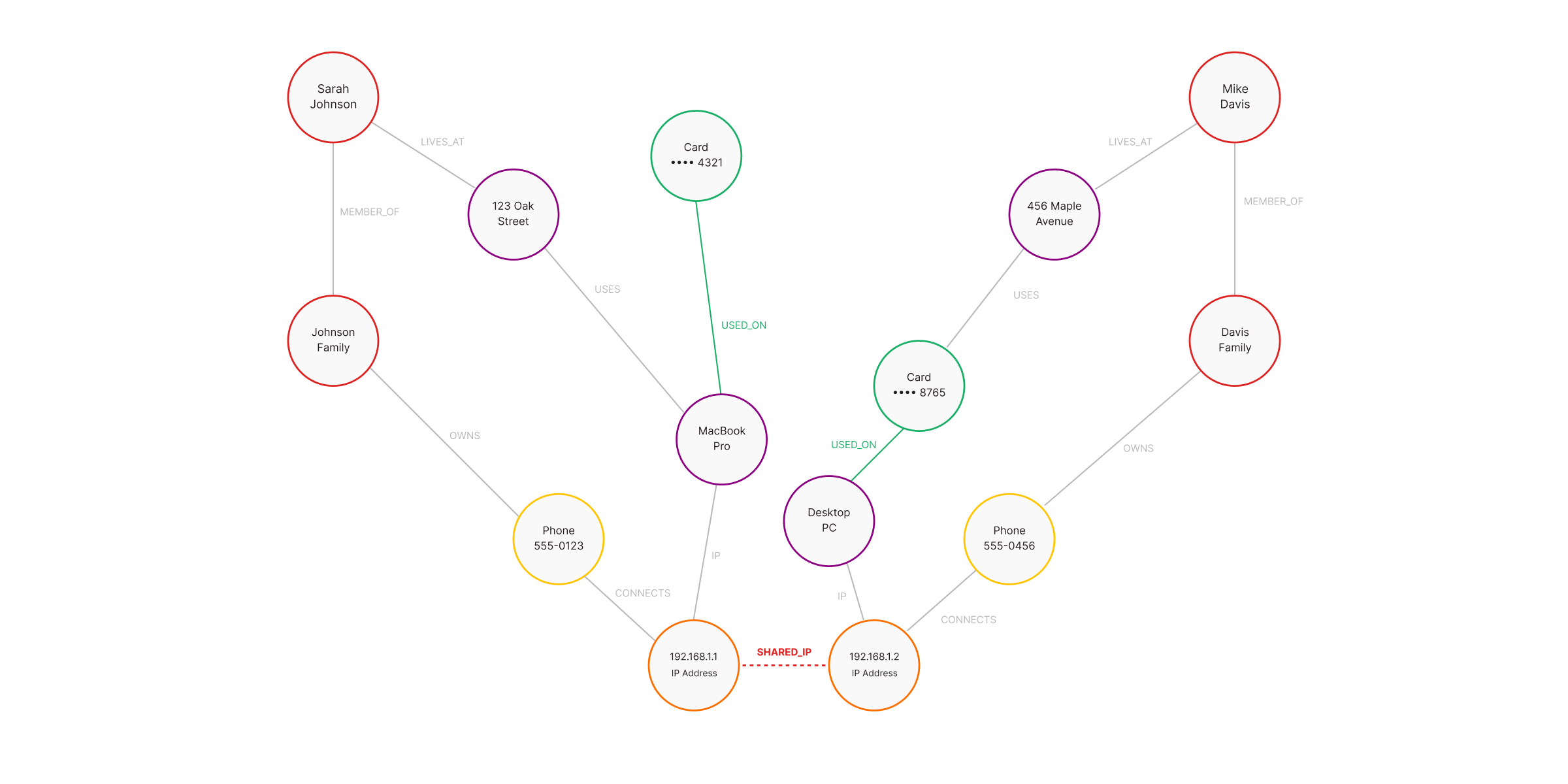
On their own, these people, households, cards, devices, and addresses may look unrelated. Once the links are modeled directly as a graph, shared infrastructure and hidden connections become much easier to trace.
That does not mean that you should replace every existing model or workflow. It means adding a structure that preserves relationships instead of losing them every time data gets flattened, handed off between teams, or reduced to a local score.
Once that structure exists, the same fraud signals can be analyzed in a different way. You can move from one suspicious event to the surrounding entities, from one beneficiary to the wider network it sits inside, or from one alert to the path that connects it to related cases.
That is what makes connected analysis practical rather than just conceptual.
What Changes When You Analyze Connections Across Workflows
The goal is not to throw away existing fraud models. The goal is to change the frame around them.
Instead of asking only whether one event is suspicious inside one workflow, connected analysis asks how that event relates to the surrounding network and whether the same structure appears across other workflows, entities, and prior cases.
That shift changes fraud work in a few important ways.
Reused infrastructure becomes easier to spot
Multiple victims, accounts, claims, or policies may connect back to the same beneficiary, address, intermediary, device, or onboarding trail. Those links are easy to miss when each case sits in its own queue.
The handoff points become visible
The riskiest part of a fraud ring is often the transition between systems. One workflow sees the setup. Another sees the transaction. Another sees the movement of funds afterward. Connected analysis makes those handoffs visible instead of letting each team inherit partial context.
Multi-hop patterns become visible
A direct connection is useful. A repeated two-hop or three-hop pattern is often more useful. That is where common actors, shared routes, and organized behavior start to emerge.
Investigation logic becomes easier to scale
Fraud investigators already think in relationships. They trace paths, sketch maps, and look for common entities across cases. Connected analysis makes that reasoning more repeatable instead of leaving it trapped in manual case work.
Feature quality improves
A model built only on isolated event fields sees what happened on one record. A model that also incorporates network position, shared exposure, path overlap, or community structure sees more of how the fraud operation actually behaves.
Why This Matters for Fraud Teams
Fraud teams do not just need more alerts. They need fewer blind spots.
That is why this matters. When systems stay disconnected, the cost shows up in several places at once.
Detection suffers because coordinated patterns are missed until later in the chain.
Investigation slows down because analysts have to reconstruct the network manually across tools and teams.
Explainability gets weaker because each system can justify its own score, but no one can clearly explain the broader structure that made the case risky.
This is especially important in regulated environments, where institutions need to show not only that a case was flagged, but why it was flagged and how the supporting evidence connects.
The pressure is growing beyond any one market. The FTC reported that consumers in the United States lost more than $12.5 billion to fraud in 2024, up 25 percent year over year. That kind of loss growth is another reminder that fraud is not just a case-volume issue. It is an adaptive network problem.
The practical shift is not simply from weaker models to stronger models.
It is from isolated decisioning to connected understanding.
Wrapping Up
Fraud rings do not care how your institution organizes its fraud stack. They operate across identities, accounts, devices, payment paths, and review workflows.
That means payment fraud, AML, account takeover, and onboarding systems can each do sensible work in isolation and still miss the broader network.
If you want to catch organized fraud earlier, the next step is not simply adding more event-level features. It is making sure the relationships between signals, entities, and workflows stop disappearing at the boundaries between teams.