The Next Drug Target Might Already Be in Your Data
Drug discovery teams do not usually suffer from a lack of data. They suffer from too many answers living in the wrong places.
Genomics data sits in one system. Proteomics data sits in another. Pathway data lives elsewhere. Compound libraries, assay results, clinical findings, and published literature each have their own formats, owners, and interfaces. Every repository can be useful on its own. The problem starts when the question you need to answer crosses all of them.
That is exactly what target discovery, repurposing, and early safety work tend to do. The critical signal is often not stored in any one source. It sits across the relationships between them.
This blog looks at why those connections are so hard to surface in R&D, what that costs discovery teams, and what may be hiding in data your teams still see in fragments.
Why Cross-Domain Relationships Matter in Drug Discovery
Researchers do not just need to know whether a gene is important or whether a compound exists. They need to understand how entities connect across biological, experimental, and clinical context. Recent work on integrated multi-omics techniques for target identification points in the same direction: useful target signals emerge when genomic, transcriptomic, proteomic, and related evidence are interpreted together rather than in isolation.
That changes the kinds of questions teams need to answer:
- Which proteins in this disease-relevant pathway are affected by variants observed in our cohort?
- Which compounds have already been shown to modulate those proteins or adjacent mechanisms?
- What evidence exists in the literature for a downstream safety concern?
- Which of these connections appear repeatedly across internal and external sources?
These are normal research questions. The problem is that many R&D environments still force teams to answer them one system at a time.
A relational database can tell you what is in a table. A literature search tool can tell you which papers mention a term. A pathway database can show curated biology. But when the real question spans all three, scientists end up stitching the answer together in notebooks, spreadsheets, or one-off workflows.
That creates avoidable friction. Discovery quality starts to depend too much on who knows which database, which identifier system, and which paper to search next.
How Siloed Systems Hide Drug Discovery Signals
Consider a simplified example.
Your team identifies a gene variant associated with an inflammatory condition. The variant may sit in a genomics platform such as DNAnexus. Protein data may sit in UniProt or an internal proteomics environment. Pathway context may come from Reactome. Compound activity may live in ChEMBL, PubChem, or an internal assay database. Relevant evidence may also be buried in PubMed or full text literature repositories.
Taken together, those sources may point to something more important:
Gene Variant → Protein → Pathway → Disease process → Compound with therapeutic or safety relevance
That is where the signal often hides. It is not missing. It is distributed. The challenge is seeing the full chain clearly enough to decide whether it is worth prioritizing, de-risking, or revisiting.
The Cost of Fragmented Context
When research data stays separated by domain, target evaluation gets narrower, repurposing opportunities become easier to miss, and safety signals emerge later than they should.
Bringing a new drug to market still takes well around a decade or over, costs billions, and sees most candidates fail during development. As this 2025 review on improving drug development efficiency argues, a major reason is still an inadequate understanding of pharmacological effects, along with poor target selection and weak translation to the intended clinical population.
In practice, that means teams often build manual bridges across tools, export files into Python, normalize identifiers, and create custom workflows just to answer what should be straightforward scientific questions.
This is not just an efficiency problem. It shapes what gets seen, what gets prioritized, and what gets left behind.
Why Traditional Research Data Workflows Fall Short
The problem is not that teams lack databases, search tools, or analytics platforms. The problem is that most of them are built to answer one type of question at a time.
A relational database can return rows that match a condition. A search system can return papers or records that mention a term. An analytics workflow can summarize what happened in one dataset. But drug discovery questions rarely stay inside one table, one repository, or one data type.
They move across them. Which target is implicated by this disease mechanism? What compound history is already relevant? Which adjacent pathways create risk? What evidence exists across internal findings and published work?
That is why traditional tabular and search-first workflows break down. The question is usually not whether one fact exists. The question is how multiple facts connect across domains.
What Better Discovery Workflows Look Like
A stronger workflow does not ask researchers to manually stitch together biology, chemistry, literature, and clinical context every time a promising signal appears.
It gives them a connected view of how entities relate and preserves traceability back to source evidence. In practice, that often means using a knowledge graph as a connection layer across existing systems rather than treating each source as a separate endpoint. That combination matters. Faster traversal without scientific traceability is not useful in pharma.
One example comes from Cedars-Sinai, where researchers built the Alzheimer’s Disease Knowledge Base (AlzKB.ai) by integrating more than 20 biomedical sources into a knwoledge graph spanning more than 234,000 entities and 1.67 million relationships.
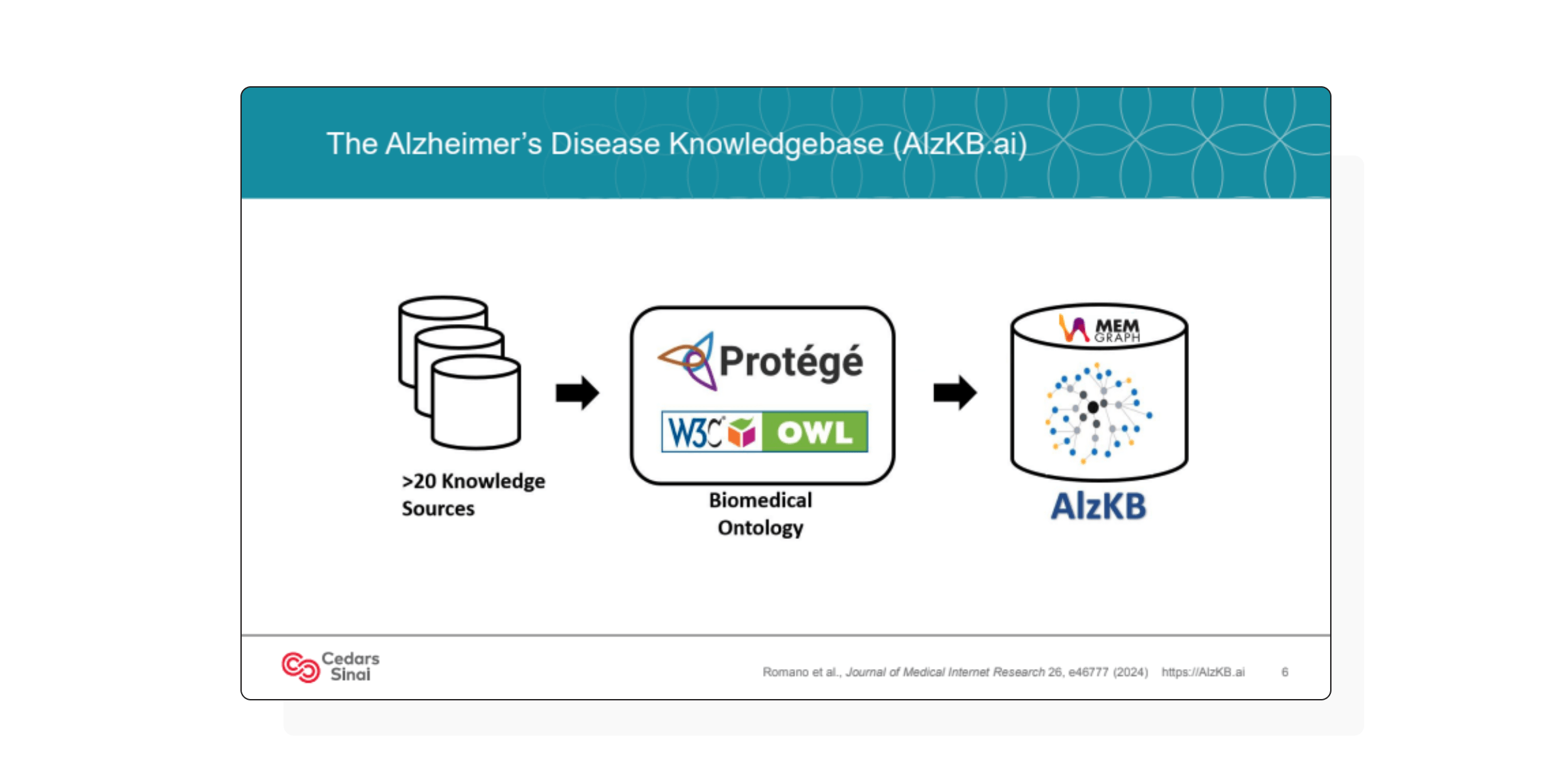
That gave their team a way to link genes, drugs, and clinical pathways in one place instead of forcing researchers to move between isolated sources. Once biomedical evidence is connected, teams can ask richer multi-step questions and move from isolated facts to testable hypotheses much faster.
The Next Target Is Not Always New
Sometimes the next valuable target is not something the market has never seen. Sometimes it is a connection your team has not been able to see clearly enough or early enough to trust.
That may be a target hidden behind identifier mismatches. A repurposing path buried in literature and assay history. A mechanism that becomes obvious only when disease, pathway, and compound evidence are viewed together. Or a safety signal that looked unimportant until it was placed in the broader chain of evidence.
The next drug target might already be in your data. The real question is whether your current systems make that visible.
Further Reading
- Success Story: How Cedars-Sinai Uses Memgraph for Knowledge-Driven Machine Learning in Alzheimer’s Research
- White Paper: How Graph-Powered AI Is Accelerating Discovery and Care in Healthcare and Biotech
- Success Story: Memgraph and GraphRAG: Transforming Diabetes Management in Healthcare
- Blog: How Can GraphRAG Speed Up Drug Discovery and Safety