CUSTOMER STORY
From 20% to 90% Accuracy: How Orbis Rebuilt RAG App with MCP

Customer
Orbis Holding
Use case
MCP-Based RAG App
Industry
IT System Integrator
Profile
Building with Memgraph
Challenge
Orbis needed a reliable way to query a real-world people surveillance dataset where values were encoded, multilingual, and relationships spanned multiple hops. Their first LLM → Cypher pipeline returned correct-looking queries that often produced no results and required manual intervention.
Solution
By introducing an MCP-based, Memgraph-powered architecture, the system began inspecting values and schema before execution. Instead of failing silently, queries were iteratively refined, corrected, and re-run until a valid answer path was found, raising success from ~20% to ~90%.
Reading time: 5min

100 million
nodes modeled efficiently

20% → 90%
improved response accuracy

100+
encoded/multilingual properties
About Orbis Holding
Orbis Holding is a Middle-East-based security system integrator assisting companies and government organizations in their e-transformation efforts by aggregating secure and reliable Information Systems. Their work spans real-world data applications involving multiple entities and their associated relationships.
The team at Orbis set out to build a question-answering system where users could type natural language queries and expect accurate results over a vast, multi-layered, complex dataset.
The team at Orbis set out to build a question-answering system where users could type natural language queries and expect accurate results over a vast, multi-layered, complex dataset.
Impact highlights
Adaptive NLQ → Cypher Query Refinement
Queries are automatically rewritten, validated against real graph data, and corrected when needed so the system can recover from empty results and return meaningful answers instead of failing silently.
Reliable Multi-Hop Graph Retrieval
Multi-layered relationship chains are handled with low latency, allowing the system to follow paths such as identity → company → vehicle → travel without breaking.
Accurate Handling of Encoded & Multilingual Values
MCP value-inspection tools allow the Q&A system to automatically map natural-language queries to 100+ encoded, abbreviated, or multilingual properties stored in Memgraph without manual intervention.
"Our dataset spans over 100 million nodes across people, companies, vehicles, and documents that requires a system built for deeply connected data."
Rida El Chall, AI Engineer at Orbis Holding

Backstory
Orbis Holding initially began with a straightforward objective: enable analysts to ask natural-language questions about individuals, vehicles, companies, and travel records stored inside their graph.
They built the first version of their system on a traditional LLM → Cypher pipeline. For early stages when data was smaller and values aligned closely with natural language, results were acceptable.
However, the more the team expanded the real-world data ingested into the graph, the more they saw that the simplicity of the early prototype would not scale. Their dataset grew to nearly 100 million nodes, with associated property formats varying across sources, and user questions became more layered.
Querying wasn’t just about matching strings anymore; context, relationships, and structure mattered increasingly more. This growth exposed the need for a more adaptive system.
They built the first version of their system on a traditional LLM → Cypher pipeline. For early stages when data was smaller and values aligned closely with natural language, results were acceptable.
However, the more the team expanded the real-world data ingested into the graph, the more they saw that the simplicity of the early prototype would not scale. Their dataset grew to nearly 100 million nodes, with associated property formats varying across sources, and user questions became more layered.
Querying wasn’t just about matching strings anymore; context, relationships, and structure mattered increasingly more. This growth exposed the need for a more adaptive system.
Challenge
The traditional LLM → Cypher chain struggled with natural-language queries that often did not align with the underlying graph’s data conventions, such as using numerical codes, multilingual attributes, and unique abbreviations, and the need for complex multi-hop traversals leading to “silent failures” or errors requiring manual intervention.
"The old LLM-to-Cypher pipeline failed because common attributes like gender were stored as numeric codes, leading to silent empty-result failures even when valid data existed."
Rida El Chall, AI Engineer at Orbis Holding
As real-world data flowed in, cracks in the original architecture became unavoidable. Natural-language queries looked simple on the surface, but the underlying graph spoke a different language. Terms the user expressed plainly rarely matched how those values were actually stored.
For instance, a query asking for:
For instance, a query asking for:
- Male users returns nothing when gender is stored as numbers such as 1 for males and 2 for females.
- Location may struggle as such attributes may appear in English, Arabic, or both, depending on the record.
- Certain properties use unique short-form labels like GD for gender.
- Multi-hop questions like “Employees at Dubai-based companies who own a car” require moving across several node types. The LLM model fails to traverse multi-hop relationships across person, company, and vehicle connected with edges Located_In and Has.
Queries such as the ones mentioned above are executed without error, yet they all produce empty result sets, creating silent failures that are impossible to trust at scale.
Plus, queries requiring more complex paths, such as “Employees at Dubai-based companies who own a car”, required multiple hops across nodes that the model struggled to traverse reliably.
Each failed output meant a human needed to step in, inspect values manually, and rewrite queries by hand. The system was functional, but not dependable.
Orbis needed a Q&A system that could adapt mid-query, correct itself, and keep going until it found the right path. A one-shot solution was no longer reliable or valuable.
Plus, queries requiring more complex paths, such as “Employees at Dubai-based companies who own a car”, required multiple hops across nodes that the model struggled to traverse reliably.
Each failed output meant a human needed to step in, inspect values manually, and rewrite queries by hand. The system was functional, but not dependable.
Orbis needed a Q&A system that could adapt mid-query, correct itself, and keep going until it found the right path. A one-shot solution was no longer reliable or valuable.
Why Memgraph + MCP?
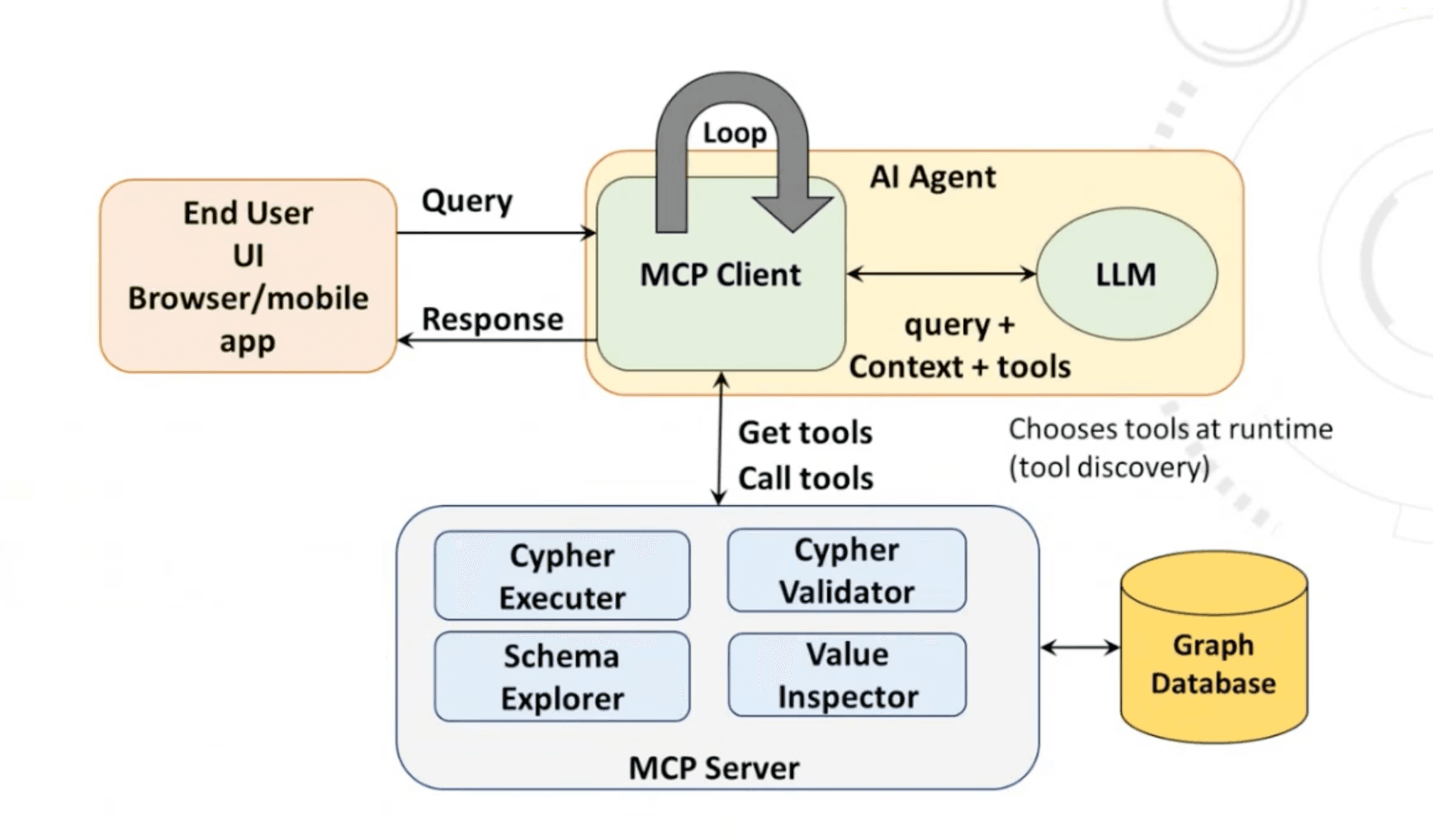
Orbis needed to implement an MCP-based architecture because their one-shot LLM → Cypher pipeline had no way to understand how values were truly stored, no ability to recover from empty results, and no mechanism to iteratively fix or refine a broken query.
"MCP allowed the LLM to dynamically select the right tools at runtime instead of relying on rigid, hard-coded logic."
Affan Abbas, Data Scientist at Orbis Holding
The team at Orbis needed a system with a built-in query refinement loop that went back and forth between the graph engine and the generated output to produce an accurate final response.
Memgraph provided the performance and structural clarity required for complex traversal, while MCP added the adaptive intelligence needed to inspect values, interpret schema, and refine queries.
Together, Memgraph + MCP delivered:
- Fast multi-hop traversal with real-time data visibility.
- Query refinement loop based on live schema and value inspection.
- Dynamic tool selection that adapts to messy, encoded, and multilingual data.
Key Memgraph Features for Orbis
Here’s what the Orbis Holding team loved about Memgraph + MCP:- Graph-Native Multi-Hop Execution
- Easily traverses and retrieves multi-layered relationships like Person → Company → Vehicle → Travel.
- This allowed users to ask complex, open-ended questions related to business-critical operations.
- Reliably Handling Messy, Real-World Data
- MCP value-inspection tools allow the system to correctly interpret 100+ encoded, abbreviated, or multilingual fields stored in Memgraph.
- This results in improved productivity with actionable results.
- Real-Time, In-Memory Graph Performance
- In-memory architecture delivers consistently low-latency retrievals, even across multi-hop chains.
- Enables fast iteration cycles during MCP-driven refinement loops without slowing down user workflows.
- Flexible Schema-Optional Design
- Supports adding new nodes and relationships without complex migrations.
- New data becomes query-ready instantly, adapting seamlessly as Orbis’ graph structure grows and changes.
"With the new approach, accuracy jumped from 20% to 90% across a 100-question evaluation set."
Affan Abbas, Data Scientist at Orbis Holding
Results
Since adopting Memgraph, Orbis Holding has been able to:
- Query a 100 million-node dataset in real time.
- Prevent silent failures and system errors, reducing debugging time.
- Execute complex multi-hop searches reliably with automated refinement loops.
Watch how Memgraph MCP Client runs cross-system workflows inside one agent flow
JumpStart your Production-Ready AI Apps