CUSTOMER STORY
Behind the Missions: How NASA Manages Talent with a People Knowledge Graph
Customer
NASA
Use case
People Knowledge Graph
Industry
Aerospace Agency
Profile
Building with Memgraph
Challenge
NASA’s People Analytics team struggled with traditional relational databases. These systems weren't built for complex, interconnected workforce data analysis covering employees, skills, projects, and education. NASA needed a database that could intuitively model these connections and perform fast, complex queries.
Solution
By moving to Memgraph’s native in-memory graph database, NASA benefited from faster, multi-hop queries and deeper workforce insights. This capability helped them efficiently identify SMEs and analyze agency-wide skill gaps. It also provided them a flexible foundation needed for future AI use cases, like a GraphRAG-powered chatbot for natural language querying.
Reading time: 4min

230k
relationships efficiently traversed

18,000
employees modeled as nodes

3+ hops
deep-path traversals
About NASA
NASA is recognized worldwide for advancing space exploration, scientific research, and technology innovation. Behind its groundbreaking missions is a large and diverse organization, with teams working across research centers throughout the United States. The agency’s ability to manage, connect, and grow its workforce is essential to supporting current projects and preparing for the next generation of exploration.
Impact highlights
Integration with LLMs for Knowledge Extraction
The team began building retrieval-augmented generation (RAG) pipelines on top of Memgraph, using large language models to extract and enrich people data from unstructured sources such as resumes and project descriptions.
Efficient Traversal Across Workforce Data
Memgraph enabled NASA’s People Analytics team to efficiently traverse multiple layers of connections, such as employees, projects, skills, and education, supporting deeper talent discovery.
Minimal Learning Curve
Memgraph’s Cypher support and Python ecosystem allowed NASA’s People Analytics team to reuse existing skills and tools, minimizing the learning curve and simplifying migration.
"We were able to pivot over to Memgraph as it was more cost effective and came with a minimal learning curve. Plus, my team is half Python, half R so they could easily go and replicate what we needed."
David Meza, Branch Chief of People Analytics team at NASA

Backstory
NASA’s People Analytics team set out to create a unified view of the agency’s employees, their skills, projects, and education data.
Their vision? A People Knowledge Graph. This graph would surface hidden expertise, highlight opportunities for collaboration, and help prepare NASA’s workforce for future mission needs.
At first, much of NASA’s workforce data lived in relational systems. These systems were not built to easily reveal complex relationships. Exploring connections like shared skills or overlapping projects was tedious. It required multiple joins and made scaling analytics difficult.
Their vision? A People Knowledge Graph. This graph would surface hidden expertise, highlight opportunities for collaboration, and help prepare NASA’s workforce for future mission needs.
At first, much of NASA’s workforce data lived in relational systems. These systems were not built to easily reveal complex relationships. Exploring connections like shared skills or overlapping projects was tedious. It required multiple joins and made scaling analytics difficult.
"A lot of our People Data is stored in a relational way. It's in a data warehouse, but that structure doesn't really work well for the analysis we needed around skill, projects, and how they connect across our agency."
Madison Ostermann, Data Scientist and Data Engineer at NASA
The team realized a new approach was needed. By modeling information in a graph structure, they could represent people, skills, projects, and organizations as nodes and relationships.
This made the data more intuitive to explore. It also enabled advanced queries about workforce composition, skill matching, and cross-center collaboration.
This made the data more intuitive to explore. It also enabled advanced queries about workforce composition, skill matching, and cross-center collaboration.
Challenge:
NASA’s People Analytics team struggled to model complex workforce connections and faced performance limitations as traditional relational databases fell short in handling the complexity of their connected data and emerging AI needs.
As NASA’s People Analytics team started building the People Knowledge Graph, they quickly ran into limitations with their existing data systems.
Relational databases, while reliable for storing structured records, made it difficult to represent and explore the complex connections between employees, skills, education, and projects. Running queries across multiple layers of data required complicated joins and workarounds, which slowed down both development and analysis.
Adding new types of information, such as inferred skills extracted from resumes or project descriptions, introduced even more challenges. Relational schemas were too rigid to easily adapt, making it harder to enrich the knowledge graph with new workforce insights.
Performance became a concern as the volume of workforce data grew. More complex queries that connected people, skills, and projects took longer to return results, limiting the team’s ability to explore the data easily.
The team also needed a foundation that could support future plans, like integrating large language models and Retrieval-Augmented Generation (RAG) capabilities. Traditional relational systems were not built for this kind of flexible, connected querying.
Faced with these challenges, the People Analytics team began looking for a graph-native solution that could better match the way their data and questions were evolving.
Relational databases, while reliable for storing structured records, made it difficult to represent and explore the complex connections between employees, skills, education, and projects. Running queries across multiple layers of data required complicated joins and workarounds, which slowed down both development and analysis.
Adding new types of information, such as inferred skills extracted from resumes or project descriptions, introduced even more challenges. Relational schemas were too rigid to easily adapt, making it harder to enrich the knowledge graph with new workforce insights.
Performance became a concern as the volume of workforce data grew. More complex queries that connected people, skills, and projects took longer to return results, limiting the team’s ability to explore the data easily.
The team also needed a foundation that could support future plans, like integrating large language models and Retrieval-Augmented Generation (RAG) capabilities. Traditional relational systems were not built for this kind of flexible, connected querying.
Faced with these challenges, the People Analytics team began looking for a graph-native solution that could better match the way their data and questions were evolving.
Why Memgraph?
When evaluating options for their People Knowledge Graph, NASA’s People Analytics team needed a database that could handle complex, connected queries efficiently, while fitting into their secure cloud environment.
"We had the opportunity to work with the Memgraph team and they were able to make quick enhancements so we were able to connect to Memgraph by using a private S3 bucket in addition to the private AWS server as opposed to just a public S3 bucket. So, that was a fantastic enhancement."
Madison Ostermann, Data Scientist and Data Engineer at NASA
The entire solution runs on NASA's secure internal AWS cloud.
AWS Commercial Environment
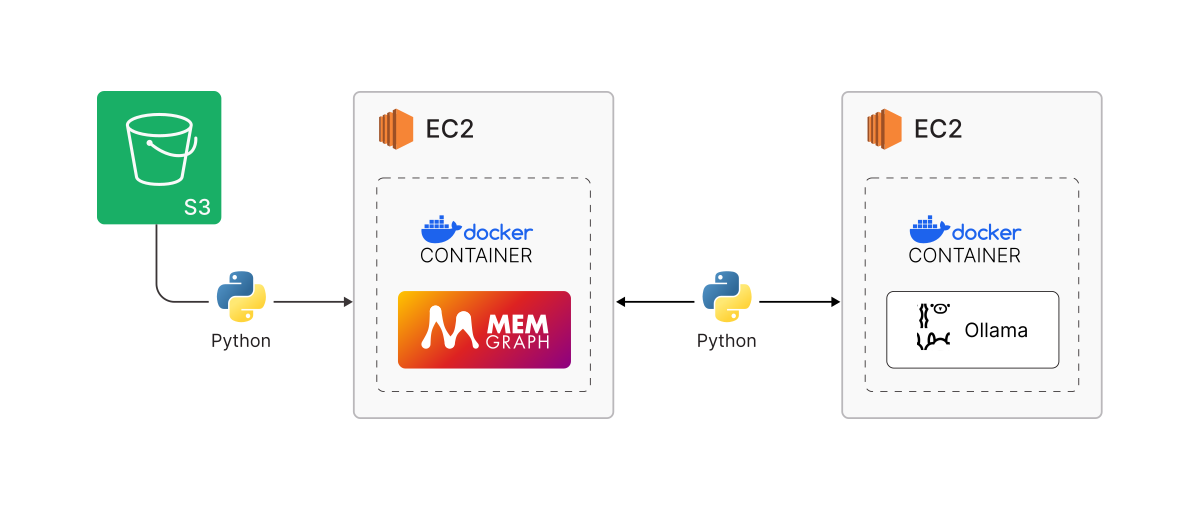
Key components of NASA’s architectural environment include:
- Memgraph running in Docker on EC2 instances.
- On-prem LLM server deployed in EC2 for skill extraction and chatbot querying.
- AWS S3 buckets for storing structured and unstructured data.
- GQLAlchemy for ingesting data from S3 to Memgraph using Cypher.
Key Memgraph Features for NASA
Here’s what NASA team loved about Memgraph:- Native Cypher Support
- Because Memgraph uses Cypher (the same graph query language NASA had experience with through Neo4j), there was minimal learning curve for the team.
- This allowed fast transition without needing to retrain developers or overhaul existing graph query logic.
- Python-Based Data Loading
- Python scripts are used to ingest structured data formats like Parquet and CSV into Memgraph using Cypher query language and GQLAlchemy, with future plans to automate the pipeline as adoption grows.
- Developer Experience and Dedicated Support
- The NASA team worked closely with Memgraph’s engineers to request and successfully implement new features, such as secure private S3 bucket ingestion.
- Along with direct support, Memgraph’s documentation and examples provided clear guidance, helping the team integrate Memgraph into their environment more easily.
- Memgraph’s responsiveness and clear documentation allowed NASA to integrate the database seamlessly into their cloud environment, helping the project stay aligned with infrastructure and security needs.
- LLM and RAG Integration
- A GraphRAG pipeline is being developed, using Memgraph to serve contextually relevant graph data to large language models.
- It is designed to efficiently address employee inquiries by extracting key information like intent, context, and sentiment from natural language queries.
- Secure S3-to-Memgraph Data Ingestion
- Memgraph’s deployment via Docker on EC2 instances within NASA’s secure internal AWS environment was essential for meeting stringent infrastructure and security requirements.
- This setup enabled secure, programmatic data ingestion from private S3 buckets, fully aligning with NASA’s internal policies for handling sensitive data.
- Cost-Effectiveness
- Compared to alternatives like Neo4j, Memgraph provided a more cost-effective solution without compromising necessary features or performance for their use case.
Results
Since adopting Memgraph, NASA’s People Analytics team has been able to:
- Build a scalable, flexible People Knowledge Graph. In pilot testing, this graph connects over 27,000 nodes and 230,000 relationships, with planned scale up to over 500,000 nodes and millions of edges.
- Pilot advanced use cases like skill gap detection, Subject Matter Experts (SMEs) discovery, and project overlap discovery.
- Lay the foundation for LLM-powered GraphRAG pipelines, making workforce querying smarter and more accessible.
Find out how Memgraph performs compared to Neo4j
Let's see how Memgraph fits into your environment