Prompt engineering vs context engineering: a practical guide for AI builders
Everyone started with prompts.
Prompt templates. System messages. Guardrail instructions. For a while, it felt like any LLM problem could be fixed if you just found the right words.
Then the apps hit real users. Suddenly the same patterns keep showing up:
- great demo, brittle production
- hallucinations on simple but domain-specific questions
- agents picking the wrong tool at the worst time
- costs creeping up as you throw more tokens at the problem
Analyst firms have started to put numbers on this. A Fortune article covering MIT's NANDA report found that around 95 percent of generative AI pilots at large companies are failing to deliver measurable return, even as adoption keeps climbing.
The underlying issues are familiar: data quality, fragmented systems, and weak governance that make it hard to move from experiment to production. In other words, the issue is not only the model. It is the environment you put around it.
That environment is what context engineering is for.
If you are building assistants that depend on policies, permissions, current data, or relationships across systems, this matters more than another clever prompt.
In this guide, we break down the difference between prompt engineering and context engineering, show where each one helps, and give you a practical path to move from prompt-only experiments to context-aware systems that use knowledge graphs and GraphRAG-style retrieval.
What Is Prompt Engineering
Prompt engineering is about talking to the model in a language it understands.
When you design prompts, you are trying to:
- clarify the task
- set the tone and style
- control output format
- add examples to steer behaviour
- wrap safety instructions around the interaction
This work matters. Clear prompts reduce ambiguity. Good examples reduce weird edge-case outputs. Consistent formats make it easier to plug the model into downstream systems.
If you are building an internal assistant that drafts emails, summarizes meetings, or rewrites documents, prompt engineering can take you surprisingly far.
Where it starts to break is when the model needs to reason about how your business actually works.
Where Prompt Engineering Breaks in Production
Prompt tweaks cannot fix missing or bad context. The model knows what it knows based on the publicly available data it was trained on. If you want it to be useful for your enterprise environment, you need to provide it with the right context. That is what context engineering is about.
You can say “think step by step” and “use the knowledge above” and “if you do not know, say you do not know.” If the model never sees the right facts, it will still guess.
This shows up in very ordinary situations:
- A sales copilot that suggests discounts that violate policy because it has never seen the latest pricing rules.
- A customer support assistant that quotes an outdated refund policy because it pulled the wrong version of a document.
- An HR assistant that answers a benefits question with a generic answer instead of the country specific rule that actually applies.
- A fraud assistant that ignores a risky pattern because relevant events live in another system that the model cannot see.
External research has started to highlight this gap. Many “hallucinations” turn out to be symptoms of poor retrieval pipelines, version drift between documents, or missing governance around which sources are considered trustworthy. When irrelevant or outdated context is stuffed into the window, the likelihood of made-up or wrong answers climbs.
If you keep iterating on prompts without touching how context is selected and governed, you are optimising around the real problem.
You do not have a prompt problem. You have a context problem.
What Is Context Engineering
Context engineering is the practice of regulating and optimising the AI environment so that the model always sees the right data, with the right structure, under the right rules, at the right moment.
It sits alongside prompting, RAG, memory, and tool use, and answers a different question.
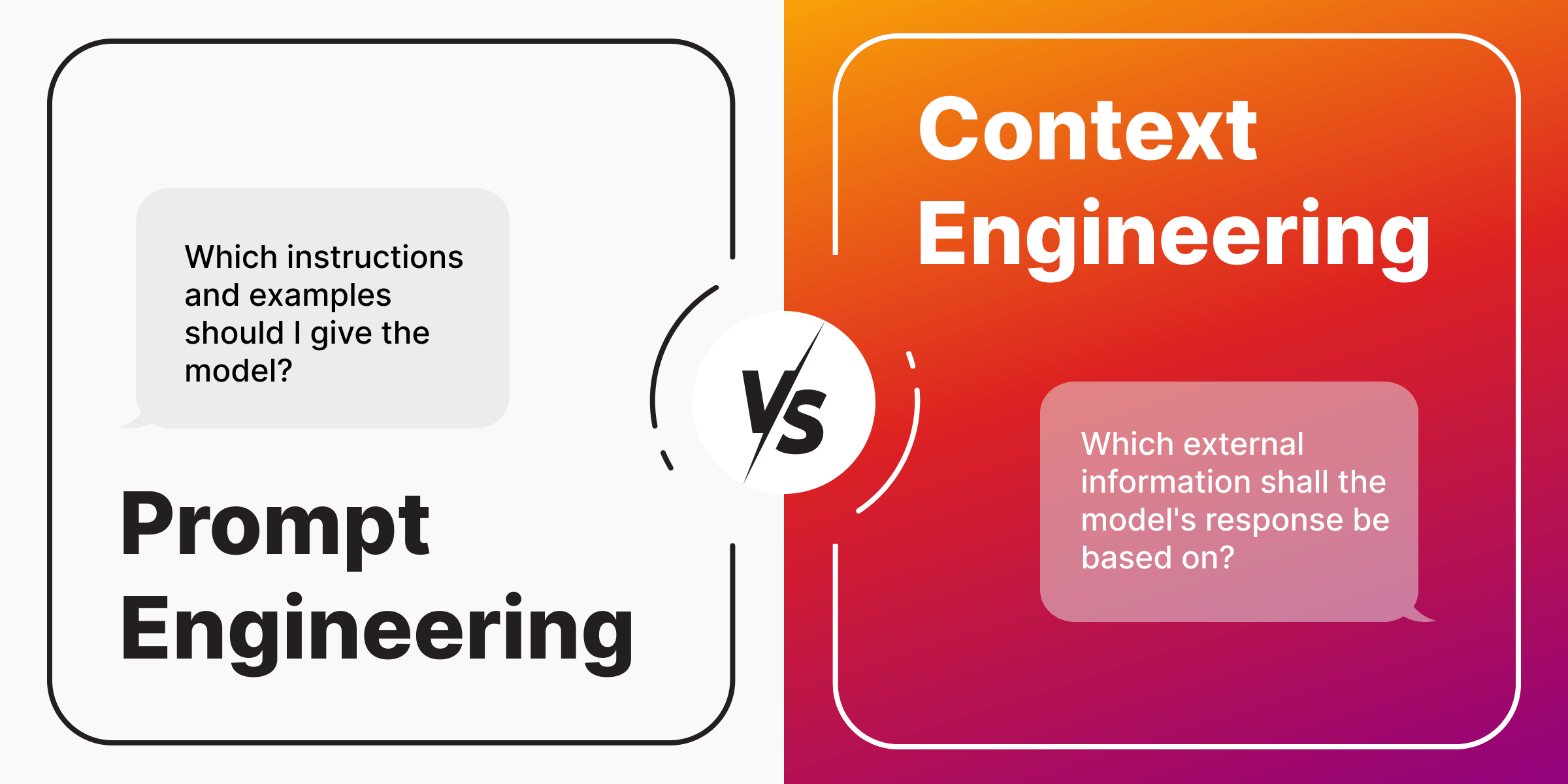
Prompt engineering asks: How should the model behave for this task?
Context engineering asks: What is the model allowed to know and use for this task?
In the context engineering framework we use in our own work and with customers, this breaks down into four core responsibilities:
- Context definition
- Curation
- Integration
- Governance
Prompt Engineering vs Context Engineering: Quick Comparison
Another way to think about the split is to treat prompt engineering and context engineering as different levers in the same system.
You can summarise it like this.
Prompt engineering:
- shapes language and behaviour
- improves clarity of instruction
- controls style and format
- sits close to the model
Context engineering:
- shapes what the model can see
- improves relevance and reliability of evidence
- controls which tools and data are in play
- sits in the architecture around the model
In healthy systems, both are present. People still write good prompts. The difference is that prompts live inside a context layer that has been designed, not improvised.
Concrete Example: A Prompt-Only HR Assistant
Consider an internal HR assistant that answers benefits questions.
The prompt might be beautifully written. It might say:
You are an HR expert. Answer questions about employee benefits. If the answer depends on location, role, or contract type, make sure to ask clarifying questions. If you do not know, say you do not know.
On a demo, this looks impressive. Ask a generic question like “How does parental leave work” and the answer sounds plausible.
Now put this in front of real employees.
- Someone in Germany asks about parental leave for part time employees on a specific contract.
- Someone in the US asks about tuition support which changed last quarter.
- Someone in the UK asks whether an old policy they found in a PDF is still valid.
If the model is only grounded in generic HR content or outdated PDFs in a vector index, it will improvise. It cannot reliably:
- look up the right country and location
- check which policy version is current
- apply exceptions for contract type
- hide information the user is not allowed to see
No amount of prompt tweaking fixes that. A context-engineered assistant behaves differently.
- Context definition ensures the system knows it needs country, office, role, contract type, and policy version.
- Curation builds a graph of policies, versions, eligibility rules, and links them to locations and roles.
- Integration uses that graph plus a document index to pull only the relevant policy and commentary into the context window.
- Governance ensures the assistant never reveals another employee’s data and always links to the current version of the policy.
Same model. Different environment. Very different risk profile.
How GraphRAG Implements Context Engineering in Practice
Classic RAG brings evidence into the context window. It is a step up from prompt-only systems because it grounds answers in retrieved documents.
GraphRAG adds another layer.
Microsoft Research introduced GraphRAG as a way to answer questions over large private corpora by building a knowledge graph from the text and then using that graph to guide retrieval and summarisation. The graph captures entities, relationships, and communities. The system can then retrieve and summarise not just “top K chunks” but the neighbourhood of information that actually matters for the question.
That is exactly what context engineering needs.
In a GraphRAG setup backed by a real-time graph database, the graph becomes your live context engine. It can:
- represent customers, products, policies, events, tickets, and more as nodes and relationships
- store business rules and constraints alongside data
- track which sources are authoritative and which are drafts
- support fast traversal when your agent needs to answer multi hop questions
When you pair this with vector search over unstructured text, you get the best of both worlds. Vectors help you find semantically relevant passages. The graph helps you keep those passages grounded in how your business is actually wired.
In practice, many teams now combine relational data, unstructured documents, and graph structure so that GraphRAG can retrieve context that is both relevant and structurally meaningful. That is context engineering in motion.
From Prompt-First to Context-First: A Practical Path
You do not need a massive transformation to start doing context engineering.
A realistic path for many teams looks like this.
-
Start from a specific workflow, not from “AI for everything.”
Pick one assistant or agent that already has usage and pain. For example, a support assistant that struggles with exceptions, or a sales copilot that keeps proposing the wrong terms.
-
Write down the context definition.
For that workflow, list the minimum entities, relationships, and policies the model must know. Be concrete. Name systems and fields.
-
Build a first graph from existing structured data.
Use an agentic migration tool such as HyGM or a similar pipeline to bring over relevant tables and relationships into a graph database. Focus on correctness, not completeness.
-
Add key unstructured knowledge.
Use tooling that can turn unstructured PDFs, docs, or wiki pages into entities and relationships, then link them to your graph entities.
-
Introduce GraphRAG into the retrieval pipeline.
Instead of retrieving only flat chunks, use the graph to find the right neighbourhood of entities and policies, then pull related documents.
-
Layer governance on top.
Implement permission checks based on user identity and role. Log retrieved context and tool calls. Add human approval for high risk actions.
-
Evaluate and iterate.
Create a small test set of real questions and measure task success, tool misuse, and token cost. Tweak context definition and graph structure as you learn.
This is incremental work. You keep your existing prompts and frameworks. You simply give them a better environment to live in.
How to Explain This to Your CTO or Product Owner
Many leaders still hear “prompt engineering” and think the work stops once the chatbot sounds clever.
It helps to reframe the conversation.
You can say:
- Prompt engineering makes the model easier to talk to.
- Context engineering makes the model safer and more useful for our business.
- Prompt work mostly affects the demo.
- Context work affects whether we can trust the system in production.
You can also point to a few patterns that show up across analyst and industry research:
- Most organisations now report using generative AI in at least one function, yet many still struggle to turn pilots into scaled value because of data and governance gaps rather than model limits.
- A significant share of AI projects fail or underperform because the underlying data is messy, siloed, or poorly governed.
- Retrieval augmented techniques are becoming a baseline expectation for enterprise grade systems, not an experimental extra.
Context engineering is one concrete way to respond to those realities without relying solely on larger models or more prompt tweaks.
When to Use Each Approach
Prompt engineering still matters. It just is no longer the main bottleneck.
Use prompt engineering when the task is stable and the main problems are tone, structure, and instruction clarity.
Use context engineering when the answer depends on current policies, user permissions, source freshness, or relationships across systems.
If you are building LLM-powered applications for marketing, sales, service, HR, finance, risk, or operations, you will eventually run into problems that cannot be patched with another clever system prompt.
At that point, the question changes.
It is no longer “How do I talk to the model.”
It becomes “How do I give the model the right view of my business for this task.”
That is context engineering. GraphRAG-backed systems with a real-time knowledge graph are one practical way to do it in production, but the principles apply regardless of which specific tools you choose.
If you want the next step with Memgraph, start with GraphRAG.
We want to help companies build GraphRAG pipelines and get started fast.
A GraphRAG pipeline POC in 2 weeks with a Memgraph license and expert setup included. If interested, register here!