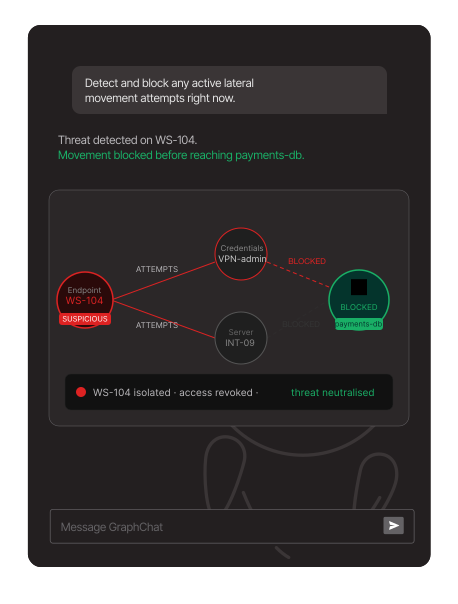
Cyber threats hide in the relationships between systems, accounts, and behaviors. Memgraph lets threat analysts traverse those connections in real time to identify patterns, trace sources, and find vulnerabilities before attackers exploit them.
A single login attempt, a single API call, a single file access looks normal. The threat only appears when you connect the dots: the same user, the same IP, the same behavior repeated across systems over time.
Tracing a source requires deep traversal
Modern attacks move laterally through systems, using legitimate credentials and trusted pathways. Finding the origin means following a chain of connections that can span dozens of nodes and multiple hops.
Dependencies compound exposure
A vulnerability in one library can propagate through every system that depends on it. Without a graph of your software dependencies, the blast radius of any exposure is impossible to calculate quickly.
How Memgraph Helps
How graph changes the security picture.
Three capabilities that change how threat detection works.
Pattern detection
Identify attack patterns before they escalate
Analyzing suspicious behavior across your network lets you predict similar actions with accuracy. Graph databases surface the relational patterns that signature-based systems miss, enabling proactive defense instead of reactive response.
Source attribution
Backtrack from incident to origin
From a security incident, Memgraph lets you traverse backwards through pathways and connections to find the source. Understanding how an attack entered and moved through your systems lets you block future attempts at the root.
Exposure mapping
Uncover vulnerabilities through dependency graphs
Model your software architecture as a graph to map dependency chains and identify which vulnerabilities affect which systems. Prioritize upgrades based on actual exposure, not guesswork.
Customer storyDeep Path Analysis to Reduce Attack Surfaces
Learn how Saporo uses Memgraph to quickly and effectively anticipate and mitigate cyber threats using real-time data analysis and performance.Read story
Capabilities
Why Memgraph.
Built for real-time, write-heavy security workloads.
Performance
In-memory architecture handles concurrent, write-heavy data at C++ speed. Threat detection that runs on live data needs the latency to match. Validate the numbers against your own workload with Memgraph's published benchmarks.
High Availability
HA replication and automatic failover keep your security graph available. Your threat detection pipeline can't have downtime windows.
Flexibility
Fits your existing security stack. Cypher-compatible with connectors for Kafka, Pulsar, and Redpanda. Custom procedures in Python and C/C++. Deploy on-premise or on AWS.
Why GraphRAG is the missing context in cyber defense
Traditional AI and security tools fall short because they lack relational context. GraphRAG combines large language models with graph-based retrieval to deliver the dimension that makes AI-powered security actually work.